What do AI and Google actually surface when a B2B buyer asks a problem or how-to question, like “how to reduce churn” or “how to improve email deliverability”? In this sample, both lean on expertise content and community, not product or pricing pages. I am Andrii Byzov, an AI-native fractional CMO and GEO consultant for B2B SaaS, and I ran 36 problem and how-to queries (top-of-funnel, informational intent) through Google (pulled via Apify) and Perplexity. The headline: on problem queries, both surfaces reward thought-leadership and community presence, and a Google AI Overview appeared on all 36 of them. This is the lane where vendors earn visibility through genuinely useful expertise content rather than a pricing page.
Key takeaways
- Problem queries universally trigger an AI Overview. A Google AI Overview was present on 36 of 36 queries, 100%, tied with segment intent for the highest of the five intents I have tested.
- Both surfaces lean on expertise and community. Top Google-ranked domains were Reddit (dominant, 20 of 36), Salesforce, YouTube, LinkedIn, Amplitude, Mailchimp, Zendesk, Paddle, Baremetrics and Cognism.
- Perplexity cited the same lane. Top Perplexity-cited domains were Reddit, Gainsight, Stripe, SaaStr, HBR, Qualtrics and Contentsquare: vendor blogs and media, not product pages.
- Per-query overlap was about 50% between Perplexity and Google, in the middle of the funnel range I have measured.
- Honest scope. ChatGPT was fully blocked on this run (0 of 36, anti-bot, two attempts), so the AI side here is Perplexity only (28 of 36, about 78%). Read it as a single-engine, directional signal.
Problem and how-to intent is the top-of-funnel complement to the four commercial intents I have mapped (discovery, segment, comparison and pricing). It is where a buyer is still framing the problem, long before they shortlist a vendor, and the one stage where your product page is almost beside the point.
Problem queries always trigger an AI Overview
The clearest signal in this dataset is the AI Overview rate. A Google AI Overview was present on 36 of 36 problem and how-to queries, 100%. That ties with segment intent (also 100%) for the highest of the five intents I have run.
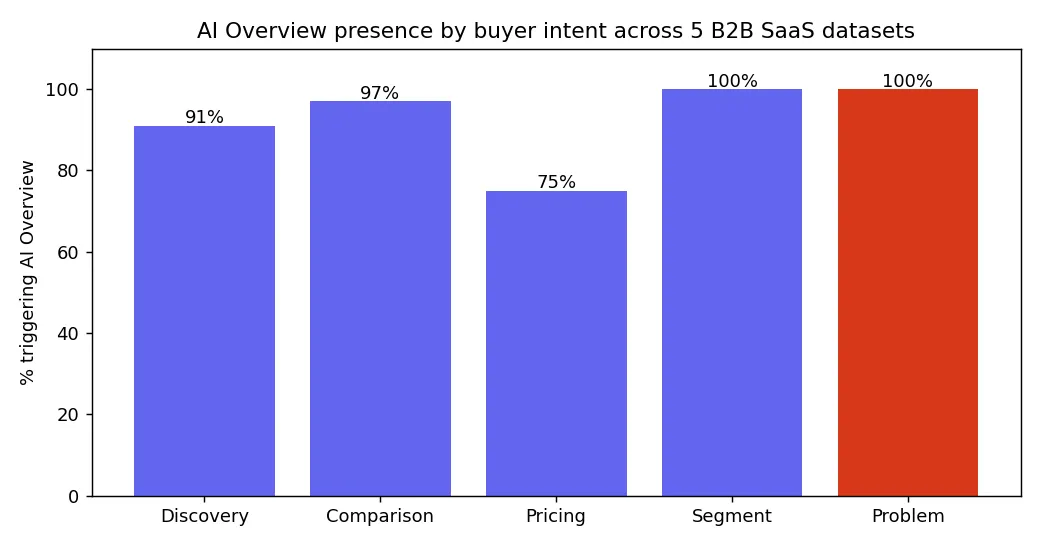
Across the five datasets the rates run: discovery 91%, comparison 97%, pricing 75%, segment 100% and now problem 100%. The pattern fits the canonical-destination idea I have used before, which I hold as a hypothesis rather than a finding. Informational queries invite synthesis: no single page settles “how to reduce churn”, so Google generates an Overview nearly every time. Pricing, the outlier at 75%, has a clear answer on the vendor’s own page, so Google reaches for synthesis less often. Problem queries sit at the opposite end, maximum synthesis, because the best answer is assembled from many sources of expertise.
The caveat stands at every stage. AI Overview presence is a separate measure from which sources get cited, and this is one US snapshot, so the rate could move on a re-run. But 100% presence on top-of-funnel questions is a strong directional signal that informational content gets summarised by AI before a buyer ever clicks.
Both surfaces lean on expertise and community, not product pages
Look at who actually ranks and gets cited, and the thought-leadership lane comes into focus. On the Google side, the top-ranked domains for these 36 problem queries were community, professional social, video and vendor expertise content.
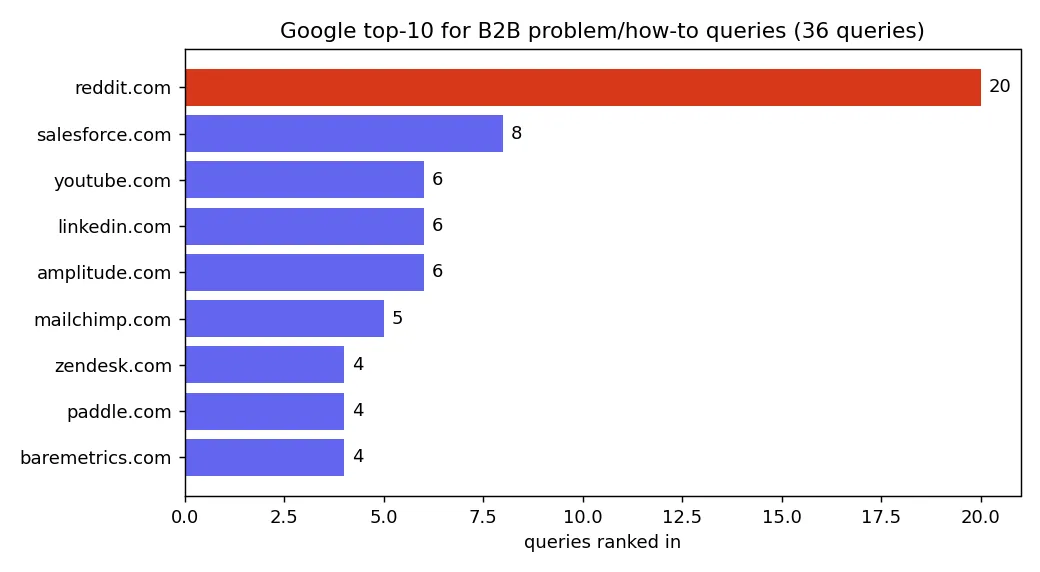
Reddit dominates again, ranking for 20 of 36 queries, followed by Salesforce, YouTube, LinkedIn, Amplitude, Mailchimp, Zendesk, Paddle, Baremetrics and Cognism. Note what is on that list: vendor blogs (Amplitude, Paddle, Baremetrics, Zendesk) that publish how-to and expertise content, professional social (LinkedIn, YouTube) and community (Reddit). What is largely absent is product and pricing pages. For a “how to” query, Google is not ranking your features page, it is ranking the page where you taught somebody something.
Perplexity, the one AI engine that answered on this run, pulls from the same lane. Its top-cited domains were Reddit, Gainsight, Stripe, SaaStr, HBR, Qualtrics and Contentsquare. Gainsight on churn, Stripe on billing, SaaStr and HBR as media, Qualtrics and Contentsquare on experience: expertise publishers, not storefronts. The directional read is that both surfaces, in this sample, reward genuinely useful expertise content and community presence over product marketing.
| Side | Top sources for problem and how-to intent | Character |
|---|---|---|
| Google top 10 | reddit (20 of 36), salesforce, youtube, linkedin, amplitude, mailchimp, zendesk, paddle, baremetrics, cognism | Community, professional social, video, vendor how-to content |
| Perplexity-cited | reddit, gainsight, stripe, saastr, hbr, qualtrics, contentsquare | Vendor expertise blogs and media, plus community |
The two lists are not identical, but they rhyme. Both feature Reddit. Both feature vendor blogs that publish substantive expertise rather than sales copy. And both reach for recognised media and authority sites. Per-query overlap between Perplexity’s cited domains and Google’s top 10 averaged about 50%, which sits between discovery and pricing on the funnel ladder I have built across these datasets.
Where problem intent fits in the funnel
This is the fifth intent dataset, extending a map I have been building stage by stage. The four commercial intents cover the buyer once they know they have a problem worth solving with software. Problem and how-to intent sits upstream of all of them, when the buyer is still learning.
That changes the GEO job. At the commercial stages, your pricing page and category positioning do real work. At the problem stage, neither does. What earns you a citation is having taught the buyer something credible: a churn-reduction guide, a deliverability playbook, a substantive community answer. The per-query overlap of about 50% tells me a Google ranking here is a reasonable, though not perfect, predictor of an AI citation, better than discovery (22%) and segment (16%), not as tight as pricing (54%).
If you want the full cross-intent picture, I synthesise all of it in the full-funnel map of B2B SaaS AI search. The unifying point holds here too: the sources that win change by intent, so problem-stage visibility is a distinct deliverable, not a byproduct of your commercial pages.
What this means for top-of-funnel visibility
Three things follow from the data, in this sample.
First, expertise content is the asset that earns problem-stage visibility on both surfaces. The vendor blogs that show up (Gainsight, Amplitude, Stripe, Paddle) are the ones that publish genuinely useful, specific how-to and analysis content. This is the be-citable-not-just-rankable idea at the top of the funnel: a page that actually answers the question is the page that gets ranked and cited.
Second, community is not optional. Reddit ranks for more than half of these queries on Google and appears on the Perplexity side too. Buyer conversations about problems happen there whether you participate or not, and that discussion shapes how both surfaces summarise the answer.
Third, do not expect your product pages to carry this stage. Problem intent is the lane where you build authority that pays off later, when the same buyer moves into the commercial intents and your name is already familiar. Measuring where you stand across all of these stages is the work I do as a fractional CMO and GEO consultant: see GEO and AI search optimization.
Methodology
I assembled 36 problem and how-to queries across B2B SaaS topics: top-of-funnel, informational phrasings such as “how to reduce churn” and “how to improve email deliverability”. This is a new, fifth intent dataset, distinct from my discovery, segment, comparison and pricing benchmarks, so the intents can be compared.
For the Google side, I pulled the top 10 organic results per query via Apify and recorded the ranking domains. A Google AI Overview was present on 36 of 36 queries, 100%, though I scored organic domains, not the Overview itself.
Be very clear on the AI side, because the scope is narrower here than in my other datasets. I attempted both ChatGPT and Perplexity. ChatGPT was fully blocked on this run by anti-bot measures, on two separate attempts, returning 0 of 36 queries. So the AI citation side of this post is Perplexity only, which answered 28 of 36, about 78%. That makes the AI findings a single-engine, directional signal, not a two-engine read like my earlier studies, and I would not weight it as heavily as the Google side.
The rest of the limits are the usual ones. This is directional, not definitive. It is US context, one snapshot on a single date, and it excludes ads, maps and other result types. AI Overview presence is a separate measure from which sources get cited. Numbers will move on a re-run. I write more about GEO on LinkedIn.
FAQ
What do AI and Google surface for problem and how-to queries? Expertise content and community, not product or pricing pages. I ran 36 problem and how-to B2B SaaS queries through Google via Apify and through Perplexity. On Google the top-ranked domains were Reddit (dominant, 20 of 36 queries), Salesforce, YouTube, LinkedIn, Amplitude, Mailchimp, Zendesk, Paddle, Baremetrics and Cognism. On Perplexity the top-cited were Reddit, Gainsight, Stripe, SaaStr, HBR, Qualtrics and Contentsquare. Both surfaces reach for thought-leadership and how-to content from vendor blogs and media, plus community. One honest caveat: ChatGPT was blocked on this run, so the AI side here is Perplexity only.
Do problem and how-to queries trigger Google AI Overviews? Almost always, in this sample. A Google AI Overview was present on 36 of 36 problem and how-to queries, 100%. That ties with segment intent (also 100%) for the highest of the five intents I have tested, above comparison (97%), discovery (91%) and pricing (75%). My read is that informational, top-of-funnel queries invite synthesis, because no single canonical page answers “how to reduce churn”, so Google generates an Overview nearly every time. The usual caveat applies: AI Overview presence is a separate measure from which sources get cited.
How much do Perplexity and Google agree on problem-query sources? About half, on a per-query basis, in this sample. Per-query overlap between the domains Perplexity cited and Google’s top 10 averaged roughly 50% for these 36 queries. That sits in the middle of the funnel range I have measured: higher than discovery (22%) or segment (16%), lower than pricing (54%). Both surfaces gravitate toward the same expertise and community sources for informational queries. Treat this as a single-engine, directional signal, because Perplexity was the only AI engine that answered on this run.
How complete is this problem-query dataset? It is directional and narrower than my other datasets on the AI side. The Google side is complete, pulled via Apify, with an AI Overview present on all 36 queries. The AI side is Perplexity only: ChatGPT was fully blocked by anti-bot measures on two attempts, returning 0 of 36, so I report Perplexity, which answered 28 of 36, about 78%. That makes this a single-engine read on the AI side. It is also a US snapshot on one date and excludes ads, maps and other result types, so treat the numbers as a signal rather than a settled measurement.