When a B2B buyer asks ChatGPT or Perplexity for software recommendations, which sources does the AI actually cite? I am Andrii Byzov, an AI-native fractional CMO and GEO consultant for B2B SaaS, and rather than guess, I ran the test. This is an original benchmark: 148 real buyer queries across 28 software categories, run through ChatGPT and Perplexity, with every cited source recorded. It captured 1,055 citations across 508 unique domains, and the headline finding is that AI search is far more fragmented than most teams assume.
Key takeaways
- AI citations are spread thin: the top 10 domains got only 17% of all citations, and 62% of cited domains appeared just once.
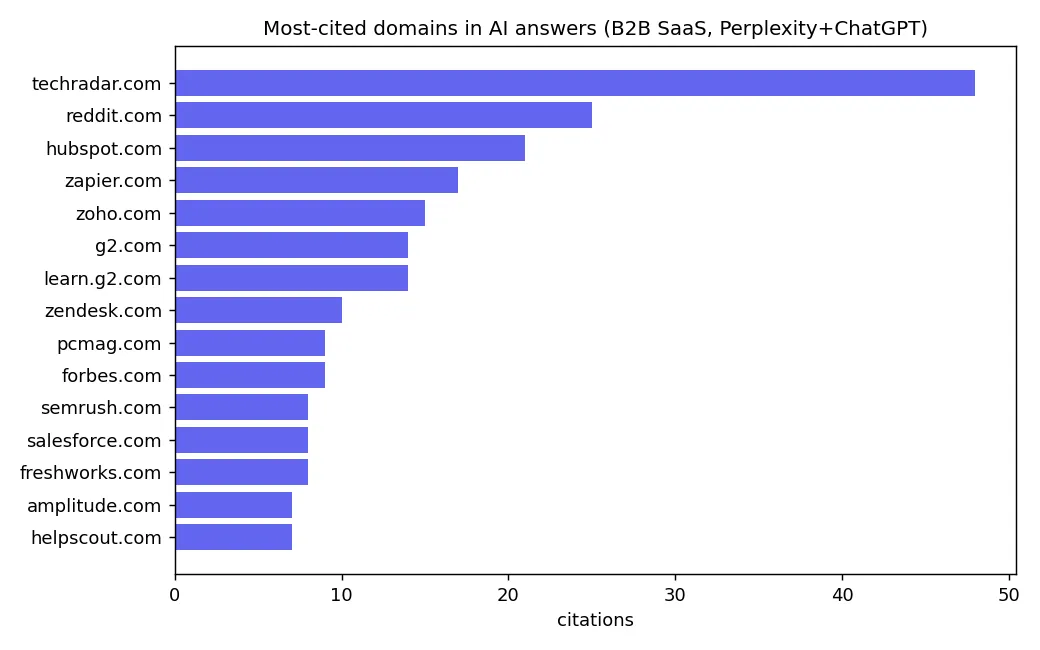
- The most-cited source was TechRadar (48 citations), followed by Reddit (25), then HubSpot, Zapier, Zoho, G2 and PCMag. The mix is tech media, communities, review sites and vendor blogs together.
- ChatGPT cited about 3.4x more sources per answer than Perplexity (6.2 vs 1.8), so the two engines reward different things.
- In my own lane (fractional CMO, GEO and AI-SEO queries) andrewbyzov.com was cited zero times. I am publishing that honestly, because it is the exact baseline I help clients move.
Method
I selected 28 B2B SaaS categories (CRM, project management, marketing automation, analytics, helpdesk, SEO tools and more) plus a set of fractional-CMO and GEO queries, and wrote 148 buyer-style prompts such as “best CRM software 2026” and “best fractional CMO services for B2B SaaS”. Each prompt was run through ChatGPT and Perplexity from a US context, and for every answer I recorded the sources the engine cited (domain and URL). ChatGPT answered 132 of 148 queries (89%) and Perplexity answered 129 (87%); the rest hit anti-bot challenges and were excluded rather than guessed. The full citation-level dataset is downloadable below.
This is a snapshot, not a law. Two engines, one geography, one date. AI engines change their behaviour often, and answers vary by account and phrasing. The value is in re-running it over time, which I intend to do.
Finding 1: AI search does not concentrate like Google
On a Google results page, the top few links capture most attention. AI citations behave differently. Across 1,055 citations, the top 10 domains accounted for just 17% of the total, the top 50 reached only 37%, and most of the long tail was made up of domains cited a single time.
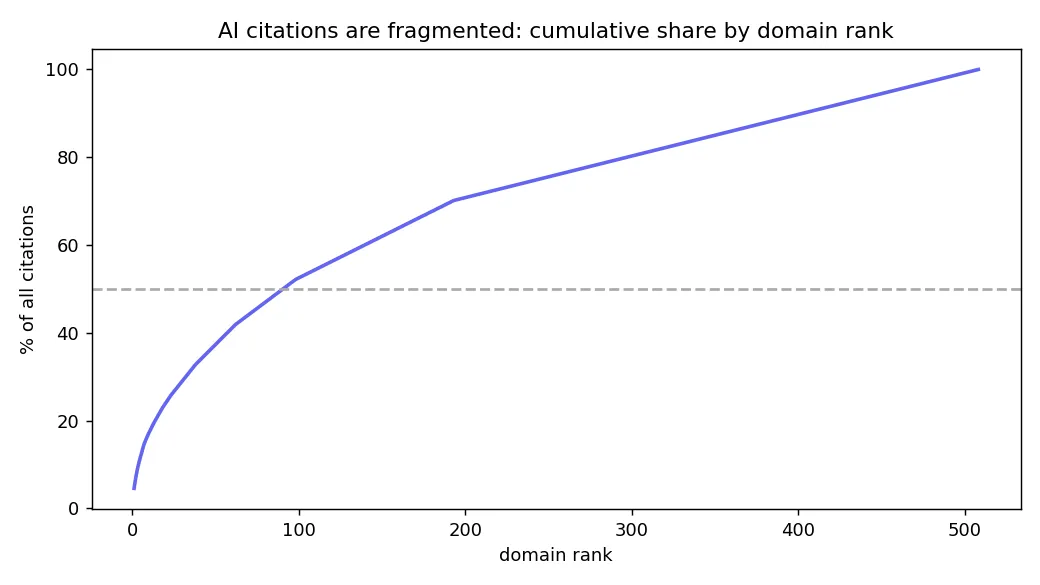
For a brand, this cuts both ways. There is no single placement that “wins” AI search, but the wide spread means there are many realistic entry points to earn a citation. It rewards breadth of credible presence over chasing one ranking.
Finding 2: the sources AI cites are a recognisable mix
The most-cited domains were not only software review sites. Tech media (TechRadar, PCMag, Forbes), a community (Reddit), vendor and marketplace blogs (HubSpot, Zapier, Zoho, Salesforce) and review platforms (G2) all appeared near the top.
| Rank | Domain | Citations | Type |
|---|---|---|---|
| 1 | techradar.com | 48 | Tech media |
| 2 | reddit.com | 25 | Community |
| 3 | hubspot.com | 21 | Vendor blog |
| 4 | zapier.com | 17 | Vendor blog |
| 5 | zoho.com | 15 | Vendor |
| 6 | g2.com (+ learn.g2) | 28 combined | Review site |
| 7 | zendesk.com | 10 | Vendor |
| 8 | pcmag.com | 9 | Tech media |
| 9 | forbes.com | 9 | Media |
| 10 | semrush.com | 8 | Vendor blog |
TechRadar led, but its 48 citations were still under 5% of the total, so it leads rather than dominates. The practical read is that this list is a usable PR and content target map: the publications, communities and platforms worth being present and accurate on.
Finding 3: ChatGPT and Perplexity reward different things
The two engines behaved very differently on citation density. ChatGPT averaged 6.2 cited sources per answer, while Perplexity averaged 1.8.
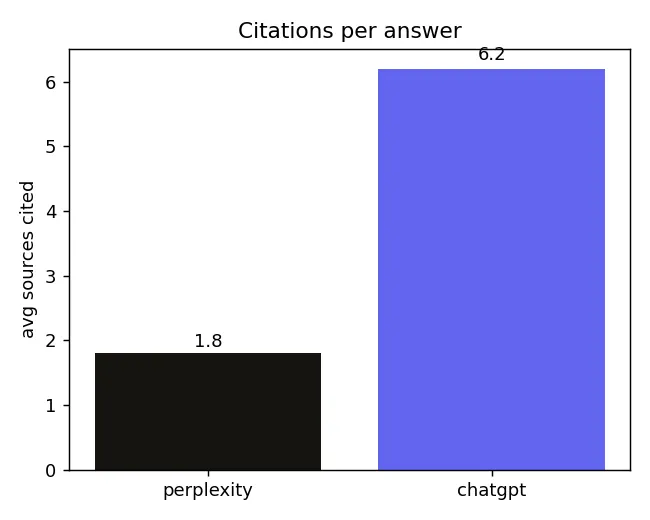
This is a measure of how many sources each engine surfaces, not of answer quality. Perplexity is more selective; ChatGPT casts a wider net. For visibility, that means breadth of credible mentions matters more for ChatGPT, while Perplexity rewards being one of the few clearly authoritative sources on a question.
Finding 4: my own category, measured honestly
I included my own lane in the benchmark: 32 queries about fractional CMOs, GEO and AI-SEO. Across all of them, andrewbyzov.com was cited zero times. The sources AI cited instead included Growtal, Profound, Scrunch AI, beOmniscient, rankedcmo and Directive.
Zero citations here means zero in this benchmark, not zero authority. My site is only weeks old with almost no inbound links, so this is the expected baseline for a new domain, and it is exactly the problem I help clients fix. It is also the honest “before” reading. I will re-run this benchmark and report whether the number moves.
What this means for your AI visibility
If you sell B2B SaaS, three things follow from the data. First, you cannot win AI search with one placement, so spread credible presence across media, communities and review platforms. Second, being mentioned and cited by third parties matters more than self-description, because AI leans on corroboration. Third, measure it: treat citation frequency as a share-of-voice metric and track it over time.
This is the work I do as a generative engine optimization consultant. If you want to see roughly where you stand, the AI visibility self-assessment is a free starting point, and AI search optimization is the broader service.
Download the data
The full citation-level dataset (engine, category, query, cited domain and URL for all 1,055 citations) is available as a CSV: ai_visibility_benchmark_dataset.csv. If you cite this benchmark, a link back is appreciated.
Read the deeper cuts
I broke the dataset into focused analyses:
- AI search citations are fragmented across 500+ domains
- ChatGPT cites 3.4x more sources than Perplexity
- Reddit is the #2 source AI cites for B2B SaaS
- The most-cited sources in AI search, ranked
- I benchmarked my own AI visibility and scored zero
I write more about this on LinkedIn.
FAQ
What is the AI Search Visibility Benchmark? It is an original dataset I built by running 148 real B2B SaaS buyer queries across 28 software categories through ChatGPT and Perplexity, then recording every source each engine cited. It captured 1,055 citations across 508 unique domains.
How concentrated are AI citations? Not very. The top 10 domains accounted for only 17% of citations, and 62% of cited domains appeared once. AI search spreads citations across a long tail rather than a small set of winners.
Which sources did AI cite most for B2B SaaS? TechRadar led with 48 citations, then Reddit with 25, then HubSpot, Zapier, Zoho, G2 and PCMag. No single source dominated.
Is this benchmark a complete picture of AI search? No. It is a snapshot of two engines, one geography and 148 queries on one date. AI engines change often and results vary, so treat it as directional. I plan to re-run it so the trend is what matters.