About 1 in 3 US B2B marketing job postings now mention AI skills. In a scrape of 180 postings on Indeed across six roles, 60 of them, or 33%, referenced terms like ChatGPT, generative AI, machine learning, AI tools, or prompting. Demand generation and content roles led, while GEO or AI-search showed up in only about 4% of postings. The honest read: AI fluency is becoming a baseline hiring signal in B2B marketing, though a mention is not the same as a hard requirement. This is one US snapshot of keyword detection, so treat it as directional.
I’m Andrii Byzov, a fractional CMO for B2B tech. I help teams turn AI from scattered tools into a working AI marketing operating system, so I ran this small scrape to see how fast the hiring market is pricing in AI fluency. For the broader published numbers on AI adoption in marketing, see my companion report on AI in B2B marketing statistics.
Key takeaways
- 60 of 180 US B2B marketing postings, or 33%, mention AI skills. That is roughly 1 in 3.
- Demand generation managers led at 50%, then content at 43%, with directors lowest at 20%.
- GEO or AI-search terms appeared in only 7 of 180 postings, about 4%, an emerging and not yet established signal.
- AI shows up first in the most execution-heavy roles, which fits where the productivity gains land.
- The honest framing: this is keyword detection of AI mentions, a demand signal, not proof that AI is formally required.
What the data shows
Across the full sample of 180 postings, 60 mentioned AI in some form. At 33%, that puts AI references in about one in three B2B marketing job descriptions in this snapshot. A year or two ago, an AI mention in a marketing job post was a novelty. In this sample it is closer to a default, at least for the roles that do the most hands-on output.
The role-level breakdown is where the story gets sharper. The pattern is not flat. It tilts strongly toward the roles that produce and ship the most.
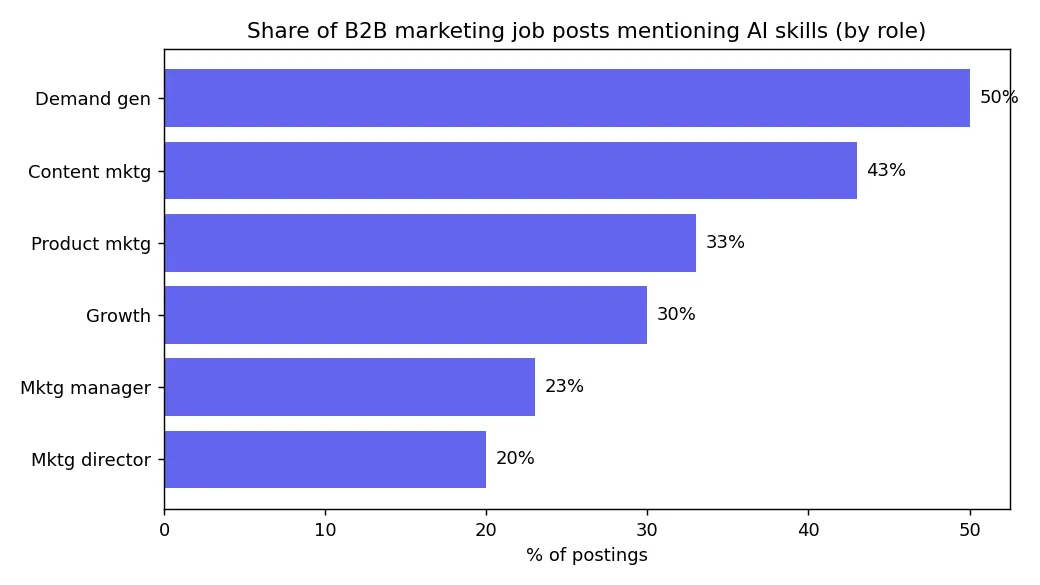
The numbers behind that chart:
| Role | % mentioning AI | n |
|---|---|---|
| Demand generation manager | 50% | 15/30 |
| Content marketing manager | 43% | 13/30 |
| Product marketing manager | 33% | 10/30 |
| Growth marketing manager | 30% | 9/30 |
| Marketing manager | 23% | 7/30 |
| Marketing director | 20% | 6/30 |
Demand generation leads at 50%, a full 30 points above marketing directors at 20%. That ordering makes intuitive sense. Demand gen and content are the roles where AI already does the most visible heavy lifting, drafting, variant generation, campaign volume, and research, so it is reasonable that employers name AI tools more often when hiring for them. Director roles, which lean more strategic and less execution-bound, mention AI least. That does not mean directors can skip AI fluency. It more likely reflects that director job descriptions tend to be written in the language of outcomes and leadership rather than tools.
The emerging gap: GEO and AI-search
There is one number worth flagging on its own. GEO or AI-search terms appeared in just 7 of the 180 postings, about 4%. So while buyers are increasingly researching vendors inside AI answers, the hiring market has barely started naming the skill of being visible there.
That gap reads as an early-mover signal. The demand-side behavior is already real, which I covered in the AI search visibility benchmark for B2B SaaS, but the supply-side language in job descriptions has not caught up. For marketers, building genuine generative engine optimization capability now is a way to be ahead of where the job market is clearly heading, with the caveat that 4% is a small count and could move fast in either direction.
What this means for hiring and careers
A few practical reads, held loosely given the sample size:
- AI fluency is becoming table stakes. When a third of postings mention AI, and half of demand gen postings do, leaving AI off a marketing resume is starting to look like a gap. The skill is shifting from differentiator to baseline.
- Execution roles feel it first. If you are in or hiring for demand gen or content, expect AI tooling to be named explicitly. Strategy and leadership roles will likely follow as the language catches up.
- GEO is the open lane. Almost no one is hiring for AI-search visibility by name yet, even though buyers live there. That is the early-mover window, and it is the kind of capability I help teams build, as in my guide on how to make your marketing team AI-native.
- Read mentions as signal, not law. A mention can be a wish, a tool reference, or a hard requirement. The trend is what matters, not any single posting.
Methodology
I scraped 180 US B2B marketing job postings from Indeed, 30 each across six roles: demand generation manager, content marketing manager, product marketing manager, growth marketing manager, marketing manager, and marketing director. For each posting I ran keyword detection over the description text for AI terms, including ChatGPT, generative AI, machine learning, AI tools, and prompt, and separately for GEO and AI-search terms. A posting counted as mentioning AI if any of those terms appeared anywhere in the text.
The caveats are real and I want to state them plainly. This is one Indeed sample, US-only, captured as a single snapshot in time, with roughly 30 postings per role, which is small. Most importantly, this is keyword detection of AI mentions in the job description, which signals demand but is not the same as a hard requirement. A keyword match cannot tell a nice-to-have from a must-have, and job descriptions are written inconsistently. So every number here is directional, not precise, and the right way to read it is as a trend signal about where B2B marketing hiring is moving. If you want to talk through what AI fluency should mean for your team, I’m on LinkedIn.
FAQ
How many B2B marketing jobs mention AI skills in 2026? In a scrape of 180 US B2B marketing postings on Indeed across six roles, 60, or 33%, mentioned AI terms like ChatGPT, generative AI, machine learning, AI tools, or prompting. That is roughly 1 in 3. It is keyword detection of mentions, not a measure of hard requirements, and one US snapshot of about 30 postings per role, so read it as directional.
Which marketing roles mention AI skills most? Demand generation managers led at 50%, or 15 of 30, then content marketing managers at 43%, or 13 of 30. Product marketing was 33%, growth marketing 30%, marketing managers 23%, and marketing directors 20%. AI shows up first in the most execution-heavy roles. The per-role samples are small, so treat the ranking as directional.
Do B2B marketing jobs require GEO or AI-search skills yet? Rarely. GEO or AI-search terms appeared in only 7 of 180 postings, about 4%, making it an emerging signal rather than an established requirement. It is a plausible early-mover area, but the job market has not caught up, and this is one snapshot of keyword mentions.
Does an AI mention in a job post mean AI skills are required? No. This data detects whether AI terms appear anywhere in the text, and a mention can be a nice-to-have, a tool reference, or a hard requirement. Keyword detection cannot tell them apart, so the honest read is that AI fluency is becoming a baseline hiring signal, not that one in three roles formally require it.