Do AI engines and Google cite the same sources when a B2B SaaS buyer searches comparison and alternative queries? In this sample, mostly not, though they align a bit more than they did for “best X” lists. I am Andrii Byzov, an AI-native fractional CMO and GEO consultant for B2B SaaS, and I ran 60 lower-funnel comparison queries (the high-buyer-intent set: “X alternatives”, “A vs B”, “is X worth it”, “X reviews”) across 10 software categories through Google (pulled via Apify), ChatGPT and Perplexity. The headline: 229 unique domains ranked in Google’s top 10, 173 were cited by AI, and only 67 overlapped. Generative engine optimization (GEO) and search engine optimization (SEO) still point at largely different lists, even at the bottom of the funnel.
Key takeaways
- For 60 comparison and alternative queries, 229 domains ranked in Google top 10, 173 were cited by AI, and only 67 overlap.
- That means 106 of 173 AI-cited domains (about 61%) never appear in Google’s top 10 for these queries.
- Per query, on average about 33% of the domains AI cited also ranked in Google’s top 10. That is higher than the 22% I found for “best X” queries, so comparison intent does pull the surfaces closer.
- AI leaned on community, vendor blogs, media and review aggregators: top AI-cited were reddit, hubspot, g2, zapier, activecampaign, salesforce, forbes and techradar.
- Google leaned on community and research: top Google-ranked were reddit (dominant), youtube, gartner, g2, trustpilot and zapier.
- Honest scope: this rests on a solid two-engine sample. Both ChatGPT and Perplexity answered 48 of 60 queries, about 80% each, so read it as directional but well-supported.
This does not mean SEO no longer matters for buyer-intent queries. It means the answer a buyer reads inside ChatGPT or Perplexity is built from a different source mix than the one Google ranks, even when the intent is as bottom-funnel as “is X worth it”.
How comparison intent compares to “best X”
In my earlier GEO vs SEO benchmark, per-query overlap between AI citations and Google’s top 10 averaged about 22% across a broad “best X” set. For these 60 comparison and alternative queries, the same per-query overlap averaged about 33%. So lower-funnel, higher-intent searches do align the two surfaces more than category listicles do, which is what you might expect: when someone searches “A vs B”, both systems gravitate toward the same review hubs and the two named vendors.
But 33% is still minority overlap. Roughly two in three of the sources AI leans on for a comparison answer are not the pages Google ranks at the top for that same query. The convergence is real and worth noting, yet it is partial. Treating a strong Google position as a guaranteed AI citation would still leave most of the AI surface uncovered here.
What the overlap actually looks like
Picture three buckets of domains for these 60 queries: ones that only rank in Google, ones in both, and ones only AI cites. The middle bucket is the smallest.
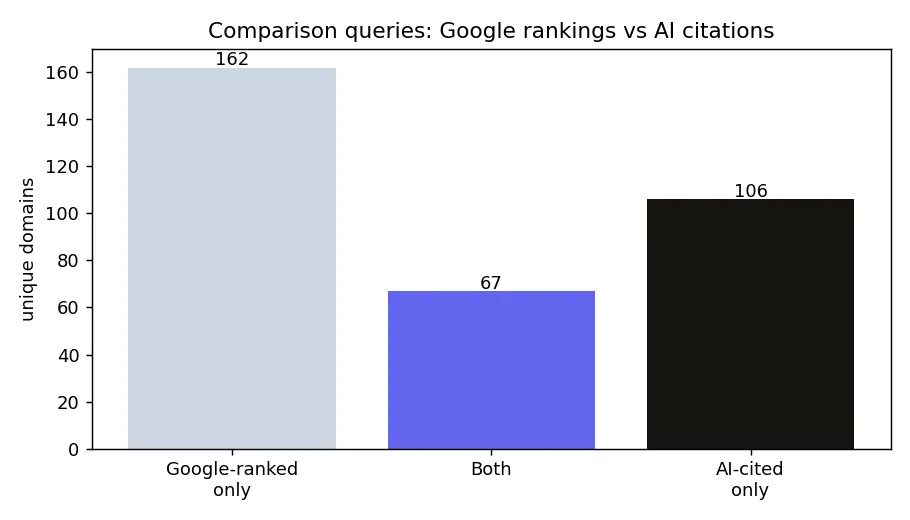
| Bucket | Unique domains | Top sources on this side |
|---|---|---|
| Google top 10 only | 162 | reddit (dominant), youtube, gartner, trustpilot |
| Both (overlap) | 67 | reddit, g2, zapier |
| AI-cited only | 106 | hubspot, activecampaign, salesforce, forbes, techradar |
The shape is the story. The “both” column, the domains an SEO program and a GEO program would share for buyer-intent queries, sits between two larger outer columns. Of the 173 domains AI cited, 106 (about 61%) never appear in Google’s top 10 for these queries. And the character of each side differs: Reddit, G2 and Zapier are the names that show up strongly on both, while the rest diverge.
AI leans vendor and media, Google leans community and research
Look at who dominates each side and a pattern appears. For comparison intent, AI cited reddit, hubspot, g2, zapier, activecampaign, salesforce, forbes and techradar most often. That is a blend of community (Reddit), vendor blogs (HubSpot, Zapier, ActiveCampaign, Salesforce publish heavily on comparisons and alternatives), media (Forbes, TechRadar) and one big review aggregator (G2).
Google’s top-ranked set for the same queries was reddit (dominant), youtube, gartner, g2, trustpilot and zapier. That skews toward community (Reddit, by a wide margin), video (YouTube), formal research (Gartner) and reviews (Trustpilot, G2). Reddit’s dominance in Google for SaaS comparisons is strong enough that I broke it out separately in why Reddit dominates Google’s SaaS comparison results.
So the directional read is: AI engines reach for vendor-authored comparison content, brand-name media, G2 and Reddit, while Google rewards community discussion, research firms and review platforms. A vendor that wins AI citations for “A vs B” may be doing so on the strength of its own well-structured comparison pages and broad media presence as much as its Reddit footprint. The two systems still weight these sources differently, even for the same buyer question.
Why this matters for buyer-intent visibility
Comparison and alternative queries are where deals are won or lost, so the gap has commercial weight. Three things follow from the data, in this sample.
First, the convergence at the bottom of the funnel is encouraging but partial. At 33% per-query overlap you cannot assume your Google work carries into AI answers, but you also should not treat the two as fully separate. There is more shared ground here than for “best X”.
Second, the source mix tells you where to invest. If AI leans on vendor blogs and media for comparisons, then publishing genuinely useful, well-structured “X vs Y” and “X alternatives” pages on your own domain, plus earning credible media mentions, plausibly helps AI visibility more than chasing a single Google ranking. If Google leans on Reddit and review sites, then community presence and review-platform standing matter for the organic side.
Third, measure both surfaces for your own comparison queries, because the winners differ. This is the work I do as a fractional CMO and GEO consultant: see GEO and AI search optimization. For the broader picture, my AI Search Visibility Benchmark covers the full B2B SaaS dataset this work builds on.
Methodology
I assembled 60 comparison, alternative and review queries across 10 B2B SaaS categories: the lower-funnel, high-buyer-intent set such as “X alternatives”, “A vs B”, “is X worth it” and “X reviews”. This is a new dataset, distinct from the “best X” benchmark.
For the Google side, I pulled the top 10 organic results per query via Apify and recorded the ranking domains. An AI Overview was present on 58 of 60 queries, about 97%, though I scored organic domains, not the Overview. For the AI side, I ran each query through ChatGPT and Perplexity and recorded cited domains. I then compared unique domains overall (229 Google, 173 AI, 67 overlapping) and computed per-query overlap, which averaged about 33%.
Be clear on the limits. The AI side rests on a solid two-engine sample: ChatGPT answered 48 of 60 queries (about 80%) and Perplexity answered 48 of 60 (about 80%), comparable coverage from both engines. The read is still directional rather than definitive. This is US context, one snapshot, on a single date, and excludes ads, maps and other result types. Numbers will move when I re-run it. I also write more about GEO on LinkedIn.
FAQ
Do AI engines and Google cite the same sources for SaaS comparison queries? Mostly not, in this sample. Across 60 comparison, alternative and review queries, 229 unique domains ranked in Google’s top 10 and 173 were cited by AI, but only 67 overlapped. Per-query overlap averaged about 33%, higher than the 22% I found for “best X”, so comparison intent aligns the surfaces a bit more, yet they still lean on largely different sources.
How much overlap is there for comparison and alternative queries specifically? Per query, on average about 33% of the domains AI cited also ranked in Google’s top 10. That beats the 22% for “best X”, but 106 of 173 AI-cited domains, roughly 61%, never appear in Google’s top 10 for these queries, so the majority divergence holds.
Which sources dominate AI answers versus Google for comparison intent? In this sample, AI leaned on community, vendor blogs, media and review aggregators: top AI-cited were reddit, hubspot, g2, zapier, activecampaign, salesforce, forbes and techradar. Google leaned on community and research: top Google-ranked were reddit (dominant), youtube, gartner, g2, trustpilot and zapier. Reddit, G2 and Zapier appear on both; the rest differ.
How complete is this comparison-query dataset? It is directional but rests on a solid two-engine sample. Both ChatGPT and Perplexity answered 48 of 60 queries, about 80% each, so coverage was comparable across engines. Google had an AI Overview present on 58 of 60 queries. This is US context, one snapshot, so treat the numbers as a signal rather than a settled measurement.