Do Google and AI search agree about B2B SaaS? It depends entirely on where the buyer is in the funnel, and that is the whole point. I am Andrii Byzov, an AI-native fractional CMO and GEO consultant for B2B SaaS, and I ran four original datasets across the buyer journey: discovery (“best X”), segment (“best X for enterprise”), comparison (“X vs Y”) and pricing (“X pricing”). Each measured how much Google’s top 10 overlaps with the sources ChatGPT and Perplexity cite, plus how often a Google AI Overview appears. This is the capstone that ties them together. The headline: Google and AI diverge most at the top of the funnel and converge toward purchase, and the sources AI trusts change at every stage. That makes generative engine optimization a funnel map, not a single tactic.
Key takeaways
- Overlap rises toward purchase. Per-query overlap between AI-cited domains and Google’s top 10 ran segment 16%, discovery 22%, comparison 33%, pricing 54%. Google and the AI engines agree more the closer the buyer is to deciding.
- Pricing triggers the fewest AI Overviews. AI Overview presence ran discovery 91%, comparison 97%, pricing 75%, segment 100%. Pricing is the one stage where a buyer is more likely to see ordinary results.
- AI cites a different, more fragmented source set than Google ranks. In the discovery benchmark alone, 1,055 citations spread across 508 domains, the top 10 held only 17%, and 68% of AI-cited domains never ranked in Google’s top 10.
- The source mix shifts by intent. Discovery leans tech media, review sites and community. Comparison adds vendor blogs and Reddit dominates Google. Pricing surfaces the vendor’s own page plus procurement sites. Segment reorders winners outright.
- GEO is per funnel stage. Because the cited sources change by intent, you need different sources and assets at discovery, comparison, pricing and segment. One content effort does not cover the funnel.
- Honest scope. Four US snapshots, single dates, ChatGPT and Perplexity completion roughly 50% to 95% by run. Directional, not definitive.
The overlap ladder: Google and AI agree more toward purchase
The single most useful pattern across the four datasets is a ladder. As a buyer moves from vague discovery toward a pricing decision, Google and the AI engines reach for increasingly similar sources.
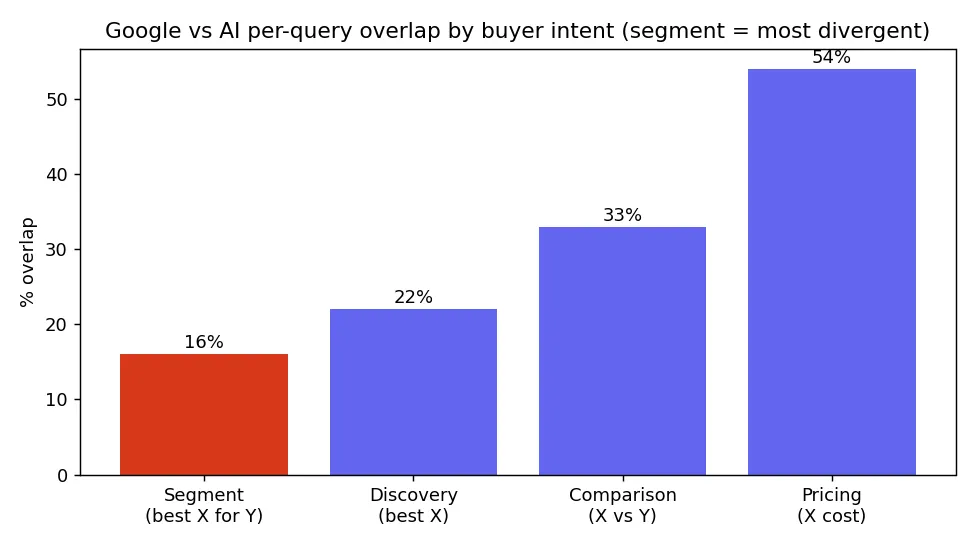
Per-query overlap between AI-cited domains and Google’s top 10 climbed steadily: segment 16%, discovery 22%, comparison 33%, pricing 54%. At the segment stage, where a buyer adds “for startups” or “for enterprise”, the two surfaces share roughly one source in six. At the pricing stage, they share more than half. That is a meaningful spread, and it has a clean explanation that I hold as a hypothesis rather than a finding: the closer the buyer gets to a decision, the more the query has a canonical destination. “Salesforce pricing” points at one obvious page, so Google and AI both reach for it. “Best CRM for enterprise” asks each engine to form a judgment, so they diverge.
The practical reading is that a Google ranking is a far better predictor of an AI citation for pricing than for segment intent. If you only measure your Google position, you are flying blind at exactly the stages, discovery and segment, where the buyer is forming a shortlist. I break each rung out separately in the discovery benchmark, the comparison-query study, the pricing-query study and the segment-query study.
AI Overviews are near-universal, except on pricing
Layer Google’s AI Overview presence on top and a second pattern appears, and it runs almost opposite to the first.
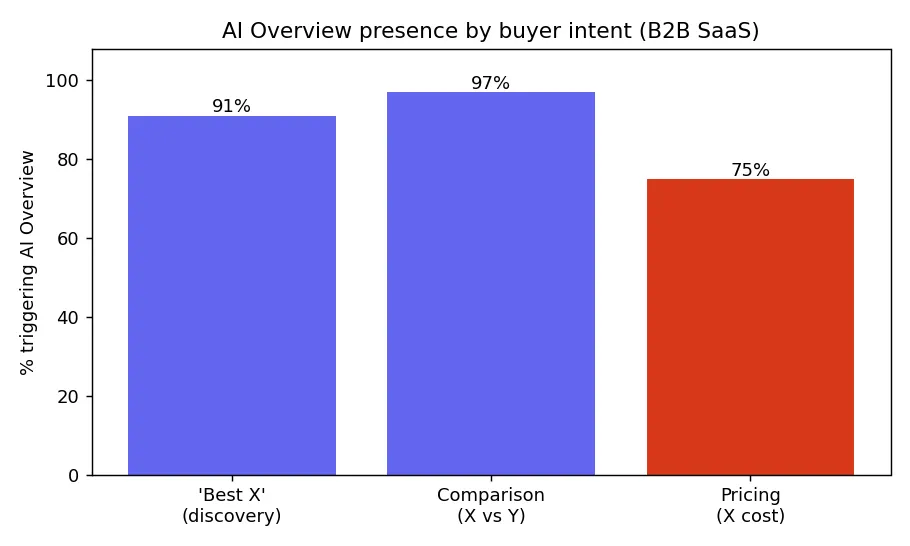
A Google AI Overview was present on discovery 91%, comparison 97%, pricing 75%, segment 100% of queries. Three of the four intents sit at or near saturation. Pricing is the outlier at 75%, the one stage where a buyer is meaningfully more likely to see ten ordinary links rather than an AI-generated answer at the top.
This fits the canonical-destination idea. Segment, discovery and comparison queries all invite synthesis, because no single page settles “best project management tool for startups” or “Asana vs Monday”, so Google generates an Overview nearly every time. Pricing has a clear answer that lives on the vendor’s own page, so Google reaches for synthesis less often. The caveat stands at every stage: AI Overview presence is a separate measure from which sources get cited, and these are single US snapshots, so the rates will move on a re-run.
AI cites a different, more fragmented web than Google ranks
Underneath both patterns is a structural fact that holds across the whole funnel: AI does not cite the same web Google ranks, and it spreads its citations far wider. In the discovery benchmark alone, the engines produced 1,055 citations across 508 unique domains. The top 10 domains held only 17% of all citations, and 68% of AI-cited domains never appeared in Google’s top 10 for the matching query.
So even at the pricing stage, where overlap peaks at 54%, AI is still pulling almost half its sources from outside Google’s top results. The rising overlap ladder narrows the gap toward purchase, but it never closes it. For a vendor this cuts two ways. There is no single placement that wins AI search, but the wide, fragmented source set means there are many realistic entry points to earn a citation. It rewards breadth of credible presence over chasing one ranking.
The source mix changes at every stage
The numbers tell you how much Google and AI diverge. The source mix tells you where to actually show up, and it reshuffles by intent.
| Intent | Google vs AI overlap | AI Overview presence | Dominant cited sources |
|---|---|---|---|
| Discovery (“best X”) | 22% | 91% | Tech media, review sites, community (TechRadar, Reddit, G2) |
| Segment (“best X for Y”) | 16% | 100% | Shifts by segment: startups pull Reddit, Zoho, HubSpot; enterprise pulls Salesforce, Oracle, SAP |
| Comparison (“X vs Y”) | 33% | 97% | Adds vendor blogs; Reddit dominates Google |
| Pricing (“X pricing”) | 54% | 75% | Vendor’s own page (AI 79%, Google 94%) plus procurement sites |
Read across the table and the implication is hard to miss. Discovery rewards being present and accurate on tech media, review platforms and community threads. Segment queries reorder the winners outright, so being cited for “best CRM” tells you little about “best CRM for enterprise”, where incumbents like Salesforce, Oracle and SAP take over. Comparison queries pull in vendor blogs and lean heavily on Reddit, especially on the Google side. Pricing queries surface the vendor’s own page far more than any other stage, cited on 79% of AI answers and 94% of Google results, alongside procurement and listing sites.
These are not variations on one tactic. They are different jobs. Earning a Reddit thread mention helps you at discovery and comparison. Owning a clear, crawlable pricing page helps you at the pricing stage and almost nowhere else. Getting into the incumbent set for an enterprise segment query is a positioning problem more than a content one.
What the full funnel means for GEO
The unifying takeaway is simple to state and uncomfortable to act on: GEO is not one tactic, it changes by funnel stage. You need different sources and assets at each stage, and you need to measure both surfaces, Google and AI, separately at each stage because their agreement varies from 16% to 54% across the funnel.
In practice that means three moves. First, plan content by intent, not by keyword: a discovery asset, a comparison asset, a pricing asset and segment-qualified assets are distinct deliverables aimed at distinct source sets. Second, prioritise by where the gap is widest. At discovery and segment, where overlap is lowest, your Google ranking is the weakest signal of AI visibility, so off-site presence on the sources AI actually cites does the heavy lifting. Third, treat pricing as the convergence point: a clean, machine-readable pricing page earns you a citation on the one stage where both surfaces agree most. I lay out the stage-by-stage moves in the GEO playbook by funnel stage.
This is the work I do as a fractional CMO and GEO consultant: mapping where a brand stands across the funnel and closing the gaps stage by stage. If that is useful, see GEO and GEO consulting. The directional read across all four datasets is that the buyers forming shortlists in AI are reading a different, more fragmented web than the one your SEO team optimises for, and the only way to know your position is to measure the funnel as four surfaces, not one.
Methodology
This post synthesizes four original datasets, each run on the same per-query overlap method so the intents can be compared directly. The intents are discovery (“best {category}”), segment (“best {category} for startups / small business / enterprise”), comparison (“{vendor A} vs {vendor B}”) and pricing (“{vendor} pricing”). For each query I pulled Google’s top organic results via Apify and recorded the ranking domains, then ran the same query through ChatGPT and Perplexity and recorded the cited domains. I computed per-query overlap between AI-cited domains and Google’s top 10, and I logged whether a Google AI Overview was present.
The cross-intent figures are: overlap of segment 16%, discovery 22%, comparison 33% and pricing 54%; AI Overview presence of discovery 91%, comparison 97%, pricing 75% and segment 100%. The fragmentation figures come from the discovery benchmark: 1,055 citations across 508 domains, top 10 holding 17%, and 68% of AI-cited domains absent from Google’s top 10.
Be clear on the limits. This is directional, not definitive. It pulls together four US snapshots, each a single date. ChatGPT and Perplexity completion varied by run, roughly 50% to 95% across the datasets, which makes the AI-cited counts conservative. AI Overview presence is a separate measure from which sources get cited, and the data excludes ads, maps and other result types. AI engines change behaviour often, so the value is in the pattern across stages, not any single reading. I write more about GEO on LinkedIn.
FAQ
How much do Google and AI agree across the B2B SaaS funnel? It depends on intent, and the agreement rises as the buyer gets closer to deciding. Per-query overlap between AI-cited domains and Google’s top 10 averaged 16% for segment queries, 22% for discovery (“best X”) queries, 33% for comparison queries and 54% for pricing queries. So Google and the AI engines pull from the most different sources at the top of the funnel and converge toward the bottom. A Google ranking predicts an AI citation far better for pricing than for segment intent, which is the opposite end of the funnel.
Which buyer intent triggers the fewest Google AI Overviews? Pricing, in this sample. A Google AI Overview was present on 75% of pricing queries, the lowest of the four intents, against 91% for discovery, 97% for comparison and 100% for segment queries. So pricing is the one stage where a buyer is meaningfully more likely to see ordinary results rather than an AI-generated answer at the top. My working explanation is that pricing has a clear canonical destination, the vendor’s own page, so Google reaches for synthesis less often than it does for queries that invite a judgment.
Do you need a different GEO approach at each funnel stage? Yes, that is the unifying takeaway across the four datasets. GEO is not one tactic, because the sources AI trusts change by intent. Discovery leans on tech media, review sites and community such as TechRadar, Reddit and G2. Comparison adds vendor blogs while Reddit dominates Google. Pricing surfaces the vendor’s own page plus procurement sites. Segment shifts the winners outright, with startups pulling Reddit, Zoho and HubSpot and enterprise pulling Salesforce, Oracle and SAP. Because the cited source set differs by stage, you need different sources and assets at each stage.
How complete is this full-funnel synthesis? It is directional, not definitive. It pulls together four US snapshots, each a single date, covering discovery, segment, comparison and pricing intent. ChatGPT and Perplexity completion varied by run, roughly 50% to 95% depending on the dataset, so the AI-cited counts are conservative. AI Overview presence is a separate measure from which sources get cited, and it excludes ads, maps and other result types. AI engines change behaviour often, so treat the numbers as a map of the terrain rather than a settled measurement.