Does ranking in Google get you cited by AI? In this sample, mostly no. I am Andrii Byzov, an AI-native fractional CMO and GEO consultant for B2B SaaS, and I ran the same 148 real buyer queries across 28 software categories two ways: who ranks in Google’s top 10 organic results (pulled via Apify) and who AI cites in ChatGPT and Perplexity (from my AI Search Visibility Benchmark). The headline: 451 unique domains ranked in Google’s top 10, 508 unique domains were cited by AI, and only 165 overlapped. Generative engine optimization (GEO) and search engine optimization (SEO) are aiming at largely different lists.
Key takeaways
- For the same 148 queries, 451 domains ranked in Google top 10, 508 were cited by AI, and only 165 overlap.
- That means 343 of 508 AI-cited domains (about 68%) never appear in Google’s top 10 for these queries, and roughly 286 Google-ranked domains are never cited by AI.
- Per query, on average only 22% of the domains AI cites also rank in Google’s top 10, in this sample.
- Domains AI cites but that did not rank in Google top 10 here include ahrefs.com, semrush.com, mixpanel.com, helpscout.com, intercom.com, notion.so, mailerlite.com and activecampaign.com.
- In my own lane, andrewbyzov.com ranks zero times in Google top 10 and was cited zero times by AI: invisible on both. I am publishing that honestly.
This does not mean Google or SEO is finished. It means winning AI answers is a separate problem from winning the organic results page, and treating them as one job leaves most of the AI surface uncovered.
What the overlap actually looks like
Picture three buckets of domains for these 148 queries: ones that only rank in Google, ones that show up in both, and ones that only get cited by AI. The middle bucket is the smallest.
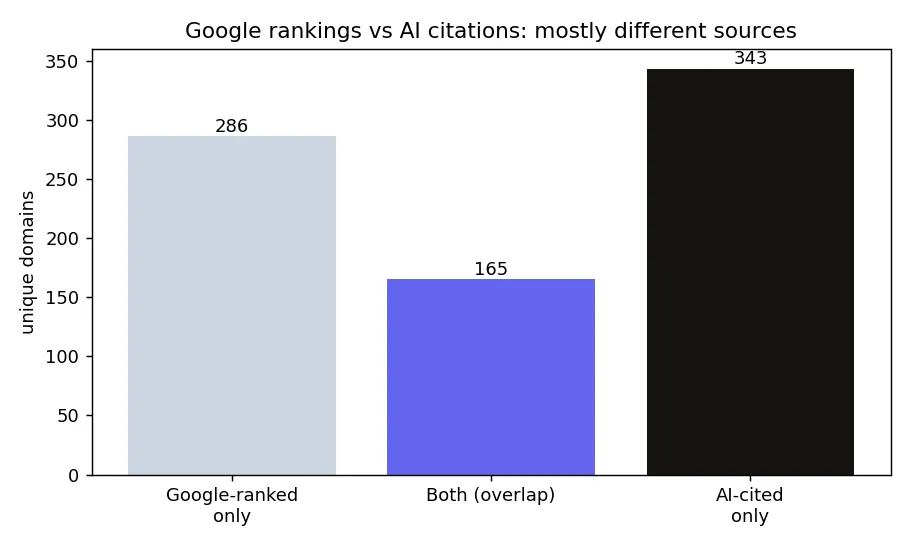
| Bucket | Unique domains |
|---|---|
| Google top 10 only | 286 |
| Both (overlap) | 165 |
| AI-cited only | 343 |
The shape is the story. The “both” column, the domains an SEO program and a GEO program would share, is dwarfed by the two outer columns. Most of what AI cites lives outside Google’s top 10, and most of what Google ranks never gets quoted back to a buyer by an AI engine. So a team that has invested years into organic rankings should not assume that work carries over into AI answers. Some of it does, in the 165-domain overlap, but in this sample most of it does not.
The per-query view is even starker
Aggregate numbers can hide what happens on a single search. So I also looked query by query: for each of the 148 prompts, what share of the domains AI cited also sat in Google’s top 10 for that same prompt? The average was about 22%. In other words, when AI builds an answer to a B2B SaaS buyer question, roughly four in five of the sources it leans on are not the pages Google is ranking at the top for that question.
That gap is the practical case for GEO as its own discipline. If 78% of AI’s cited sources, on average, are not in Google’s top 10, then optimizing only for Google’s top 10 leaves the large majority of AI’s citation behaviour untouched. You can be doing SEO well and still be absent from the answer a buyer actually reads.
Strong brands AI cites that Google did not rank
The mismatch is not random noise. Look at the names. Among domains AI cited for these queries but that did not appear in Google’s top 10 for the same queries: ahrefs.com, semrush.com, mixpanel.com, helpscout.com, intercom.com, notion.so, mailerlite.com and activecampaign.com. These are not obscure sites. They are established category brands.
What seems to happen, directionally, is that AI engines reach for well-known entities as references even when those entities are not ranking organically for that exact phrasing. The model appears to “know” these brands as authorities on their category and cites them, while Google’s ranking for the specific query rewards a different set of pages, often listicles, review aggregators and SEO-tuned posts. That is a useful clue for GEO: building recognizable entity authority across the web can earn citations that pure on-page SEO for a single query does not.
It also explains why some vendors feel invisible in AI despite ranking well, and why others get cited without obvious top rankings. The two systems are scoring different things.
My own category, measured honestly
I will not exempt myself. Across my 16 fractional-CMO and GEO queries, andrewbyzov.com ranks in Google’s top 10 zero times and was cited by AI zero times. I am invisible on both axes for my own lane. Meanwhile rivals such as Reddit, Kalungi, Growtal, Geisheker and Directive Consulting do rank in Google for these queries, and the AI benchmark cited a different set of competitors.
Zero and zero is the honest baseline for a domain that is only weeks old with almost no inbound links. It is also the exact “before” reading I help clients move. I would rather publish my real starting line than imply I have already solved it. I will re-run both measurements and report whether either number moves.
What this means for your AI visibility
Three things follow from the data, in this sample. First, GEO is not a byproduct of SEO. The overlap is real but partial, so AI visibility needs its own plan, its own targets and its own measurement. Second, entity authority matters: AI cited strong category brands even when they were not ranking, which favours broad, credible, corroborated presence over single-query on-page tuning. Third, measure both surfaces separately, because a win in one does not reliably transfer to the other.
This is the work I do as a GEO consultant. If you want the discipline framed end to end, what generative engine optimization is covers the foundations, and GEO and AI search optimization are the services that act on findings like these.
Methodology
I used the same 148 buyer-style queries across 28 B2B SaaS categories from my AI Search Visibility Benchmark. For the Google side, I pulled the top 10 organic results per query via Apify and recorded the ranking domains. For the AI side, I reused the cited domains from the benchmark, drawn from ChatGPT and Perplexity. I then compared unique domains overall (451 Google, 508 AI, 165 overlapping) and computed per-query overlap, which averaged about 22%.
This is a directional snapshot, not a law. The Google side is one top-10 organic capture, US context, on a single date, and excludes ads, maps, AI Overviews and other result types. The AI side covers two engines and can shift by account, region and phrasing. Numbers will move when I re-run it. The full query-level comparison is downloadable below.
Download the data
The query-level comparison (each query with its Google top-10 domains, AI-cited domains and the overlap) is available as a CSV: geo_vs_seo_dataset.csv. If you cite this analysis, a link back is appreciated. I also write more about GEO on LinkedIn.
FAQ
Is GEO the same as SEO? Not in this sample. Of 508 unique domains AI cited, only 165 also ranked in Google’s top 10 for the same 148 queries. About 343 AI-cited domains, roughly 68%, never appeared in Google’s top 10. GEO is a distinct discipline, not a relabel of SEO.
How much overlap is there between Google rankings and AI citations? Per query, on average only about 22% of the domains AI cited also ranked in Google’s top 10. Overall, 451 domains ranked in Google top 10 and 508 were cited by AI, but only 165 overlapped.
Which sources does AI cite that Google does not rank? In this sample, examples include ahrefs.com, semrush.com, mixpanel.com, helpscout.com, intercom.com, notion.so, mailerlite.com and activecampaign.com. Many are strong category brands AI surfaces as references even when they are not ranking for that exact query.
Does ranking in Google get you cited by AI? Not reliably, based on this data. Ranking in Google’s top 10 and getting cited by AI are largely different outcomes here. This is directional: Google top 10 organic, US, one date, with two AI engines. Treat it as a signal that GEO needs its own work, not proof that SEO no longer matters.