When a B2B SaaS buyer types a comparison query into Google, do they see an AI Overview? In this test, almost every single time. I am Andrii Byzov, an AI-native fractional CMO and GEO consultant for B2B SaaS, and rather than guess, I ran the queries. I put 60 lower-funnel comparison queries (the buyer-intent set: “A vs B”, “is X worth it”, “X reviews”, “X alternatives”) through Google in a US context, and 58 of them (97%) returned a Google AI Overview. Two whole sub-intents, “X vs Y” and “reviews”, hit it 20 of 20 and 10 of 10. The short version: at the comparison and decision stage, the AI Overview is effectively the default answer surface, not an edge case.
Key takeaways
- I ran 60 B2B SaaS comparison queries across four sub-intents through Google (US, one date).
- 58 of 60 (97%) returned a Google AI Overview, higher than the 91% I measured for a broad “best X” set.
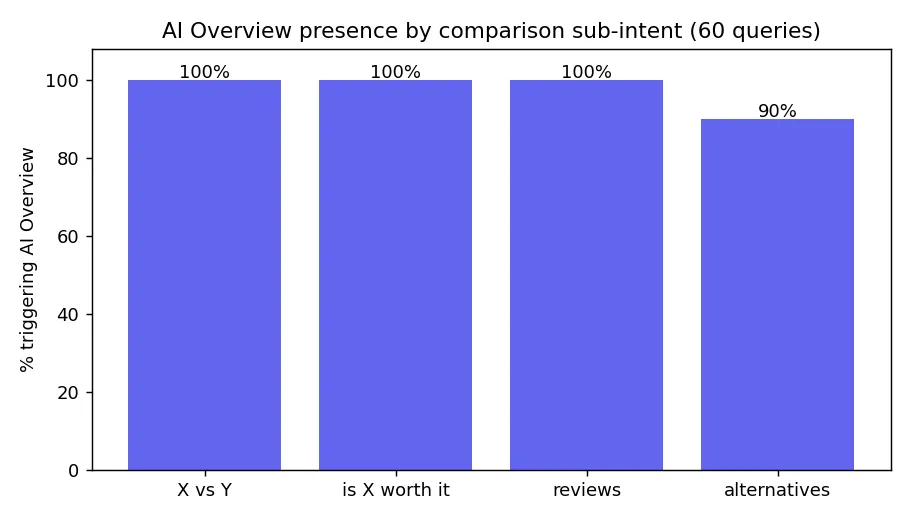
- By sub-intent: “X vs Y” 20 of 20 (100%), “is X worth it” 10 of 10 (100%), “reviews” 10 of 10 (100%), “alternatives” 18 of 20 (90%).
- This measures presence, whether an AI Overview appeared, not which sources it cited. Those are different questions, and I am only answering the first here.
- The practical read: zero-click and get-cited pressure is highest exactly where buyers are closest to choosing, so it is worth planning for rather than treating as rare.
What 97% actually means (and what it does not)
It is easy to overread a number like this, so let me be precise about scope. This test answers one question: when a B2B SaaS buyer runs a comparison or decision query, does Google show an AI Overview? In 58 of 60 cases, yes. That is a strong signal that for comparison intent the AI Overview has moved past “common” to something close to default.
It also sits above my earlier reading. In 91% of B2B SaaS buyer queries trigger a Google AI Overview, a broad “best X” set returned an Overview on 91% of 148 queries. This comparison set returned one on 97% of 60. I will not overclaim the cause, but the direction is consistent with a simple idea: the closer a query is to a buying decision, the more reliably Google answers it with a synthesized panel.
What this test does not do is tell you which sources sit inside that AI Overview. Detecting that a panel appeared is a different extraction from recording the links it cites. I am not claiming, from this data, that any particular site is or is not cited. I only know the panel was there. If you want the citation layer for these same queries, that is the separate companion analysis in AI vs Google for SaaS comparison queries, which looks at who gets cited versus ranked rather than whether the Overview appears.
Presence by sub-intent
The headline 97% hides a useful detail: three of the four sub-intents were effectively absolute, and only “alternatives” dipped below 100%.
| Sub-intent | % with AI Overview | n |
|---|---|---|
| X vs Y | 100% | 20 |
| Is X worth it | 100% | 10 |
| Reviews | 100% | 10 |
| Alternatives | 90% | 20 |
| Overall | 97% | 60 |
The two queries without an Overview both fell in the “alternatives” bucket. I would not read much into which two missed, given the small counts, but the shape is clear: direct head-to-head (“vs”), worth-it judgement and review intent each triggered an Overview on every query I tested, and even the weakest sub-intent here ran at 90%. Across the board, this is a higher floor than the “best X” set, where roughly one query in eleven came back with no Overview at all.
Why presence alone changes the playbook
Even without the citation layer, presence at 97% on comparison intent is consequential, arguably more so than the 91% on “best X”. The reason is where these queries sit in the funnel. “Best project management software” is a buyer browsing. “Asana vs Monday”, “is Notion worth it” and “ClickUp reviews” are a buyer deciding. If an AI Overview occupies the top of the page on essentially all of those, then the synthesized summary is the first thing your buyer reads at the exact moment they are closest to choosing.
That pushes two old edge cases into the mainstream, right at the decision point. First, zero-click behaviour: when a synthesized answer sits above the results, more buyers can resolve a comparison without clicking through to any vendor. Second, the get-cited problem: if the Overview is the default surface for “A vs B”, then being represented inside that surface starts to matter as much as ranking beneath it. To be clear, I am inferring the strategic implication from presence here, not proving a citation outcome.
Methodology
I assembled 60 comparison and decision queries across B2B SaaS categories, split into four sub-intents: “X vs Y” (20 queries), “is X worth it” (10), “X reviews” (10) and “X alternatives” (20). This is the lower-funnel, high-buyer-intent set, distinct from the broad “best X” benchmark.
I ran each query through Google in a US context and recorded a single binary per query: did the response include a Google AI Overview, yes or no. Of the 60 queries, 58 returned one (97%). By sub-intent: “X vs Y” 20 of 20, “is X worth it” 10 of 10, “reviews” 10 of 10, and “alternatives” 18 of 20. I scored presence only, not the sources inside the panel.
A few honest limits. This is a 60-query US snapshot on a single date, and some sub-intents have as few as 10 queries, so per-sub-intent rates are based on small counts and a single miss moves them several points. Presence is not its cited sources. AI Overview triggering is also not deterministic: it varies by exact query phrasing, region, signed-in account and device, and Google adjusts the behaviour frequently. So read 97% as a directional snapshot of how universal AI Overviews have become for comparison intent, not as a fixed constant. The trend over repeated runs is more meaningful than any single reading.
What to do with this
If you sell B2B SaaS, the working assumption should now be that an AI Overview greets your buyer on essentially every comparison and decision query in your category, the queries closest to a purchase. That does not mean panic; it means planning. Treat the Overview as the default first impression at the bottom of the funnel, make your comparison and “vs” content easy for an answer engine to quote accurately, and measure your presence in AI surfaces as a metric in its own right.
If you want help getting your brand represented in AI search, that is the core of my generative engine optimization work, and AI search optimization is the broader service. For the wider pattern across all buyer queries, see 91% of B2B SaaS buyer queries trigger a Google AI Overview, and for who gets cited inside these comparison panels, AI vs Google for SaaS comparison queries. I also write about this on LinkedIn.
FAQ
How often do B2B SaaS comparison queries trigger a Google AI Overview? In this test, 58 of 60 B2B SaaS comparison queries (97%) returned a Google AI Overview when run through Google in a US context on one date. “X vs Y” was 20 of 20 (100%), “is X worth it” was 10 of 10 (100%), “reviews” was 10 of 10 (100%), and “alternatives” was 18 of 20 (90%). That is higher than the 91% I found for “best X” queries, so the AI Overview looks effectively universal at the comparison stage, though triggering varies by query, region and account and changes often.
Why is the AI Overview rate higher for comparison queries than for “best X” queries? I cannot prove the cause from this data, only report the gap. My earlier “best X” set returned an AI Overview on 91% of 148 queries; this comparison set returned one on 97% of 60. One plausible read is that comparison and decision intent is exactly the kind of question a synthesized answer is built to resolve, so Google triggers an Overview almost every time. Treat that as a hypothesis, not a finding, given the small per-sub-intent counts.
Does this data show which sources the AI Overview cited? No. This test only measured whether an AI Overview appeared (presence), not which sources it linked to inside the panel. Identifying who gets cited needs a separate extraction, which I cover for comparison intent in a companion post. I am not claiming to know who is cited from this presence data.
How reliable is this 97% figure? Treat it as directional, not absolute. Presence was detected in a US context on a single date across 60 queries, with as few as 10 per sub-intent. AI Overview triggering varies by query phrasing, region and account, and Google changes the behaviour often. The value is in the pattern, that comparison intent triggers an Overview nearly every time, and in re-running it over time.