Do AI engines cite vendors’ own blogs when a buyer asks “X vs Y” or “X alternatives”? In this sample, yes, and more than many marketers expect. I am Andrii Byzov, an AI-native fractional CMO and GEO consultant for B2B SaaS, and I ran 60 comparison, alternative and review queries through ChatGPT and Perplexity to log which sources got cited. The headline: alongside neutral review sites and media, vendor blogs earned a notable share of the citations on these competitive queries. Zapier and G2 tied at the top with 8 citations each, but the cluster just below was thick with company-owned content like Monday.com, Salesforce and Mailchimp. Generative engine optimization (GEO) on your own comparison pages looks like a real lever, not a wasted effort.
Key takeaways
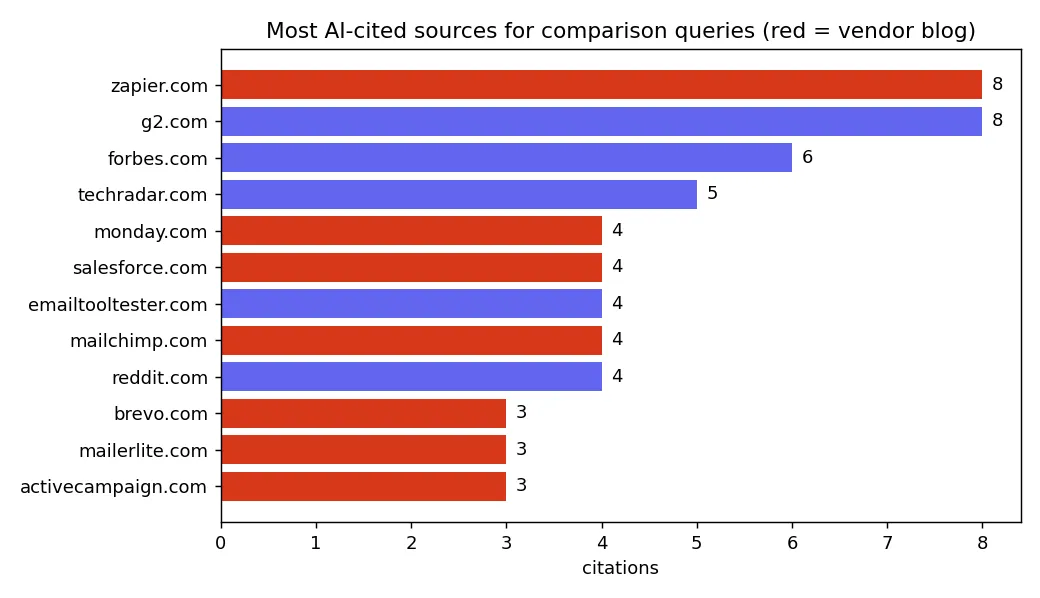
- Across 60 comparison and alternative queries, the most-cited sources were Zapier (8) and G2 (8), then Forbes (6) and TechRadar (5).
- The next cluster, at 4 citations each, was Monday.com, Salesforce, EmailToolTester, Mailchimp and Reddit, followed by Brevo, MailerLite, ActiveCampaign, Klaviyo and ClickUp at 3 each.
- Count the vendor blogs in that list: Zapier, Monday.com, Salesforce, Mailchimp, Brevo, MailerLite, ActiveCampaign, Klaviyo and ClickUp all earned citations with their own content.
- The rest were review sites (G2, EmailToolTester) and media (Forbes, TechRadar), so the answer mix is broad, not vendor-only.
- Practical read: vendors that publish strong “X vs Y” and “X alternatives” content can earn AI citations on their own competitive queries.
- Honest scope: this is a 60-query US snapshot, the ChatGPT side was thinner (about 50% completion), and a citation count is visibility, not endorsement.
This does not say AI prefers vendors, or that any of these tools is better than its rivals. It says that on the exact queries where a competitor might hope to be the only voice, the vendor’s own content frequently made it into the answer too.
What the citation counts show
The pattern is easiest to see when you lay the sources side by side and mark which ones are vendor blogs.
| Rank | Source | Citations | Source type |
|---|---|---|---|
| 1 | Zapier | 8 | Vendor blog |
| 1 | G2 | 8 | Review site |
| 3 | Forbes | 6 | Media |
| 4 | TechRadar | 5 | Media |
| 5 | Monday.com | 4 | Vendor blog |
| 5 | Salesforce | 4 | Vendor blog |
| 5 | EmailToolTester | 4 | Review site |
| 5 | Mailchimp | 4 | Vendor blog |
| 5 | 4 | Community | |
| 10 | Brevo | 3 | Vendor blog |
| 10 | MailerLite | 3 | Vendor blog |
| 10 | ActiveCampaign | 3 | Vendor blog |
| 10 | Klaviyo | 3 | Vendor blog |
| 10 | ClickUp | 3 | Vendor blog |
Read down the source-type column and the surprise lands. Of the 14 named sources, nine are vendor blogs. Two are review sites, two are media, and one is community. A reasonable prior, going in, is that comparison and alternatives queries belong to neutral review hubs, since that is the “trusted third party” instinct. The data here pushes back on that prior, at least for this query set.
Why vendor blogs show up at all
It helps to think about what a comparison query actually asks for and where that content lives. When someone searches “Mailchimp alternatives” or “Klaviyo vs Brevo”, a lot of the best-structured, most directly responsive pages on the open web are published by the vendors themselves. Companies like Zapier, Monday.com and Salesforce run large content operations that include head-to-head comparisons, alternatives roundups and migration guides. Those pages are written to answer the exact question, with clear entity names, feature tables and plain-language summaries.
AI engines reach for content that cleanly answers the prompt. A well-built vendor comparison page often fits that shape, so it gets pulled in next to G2 and TechRadar. That is the mechanism, as far as this sample can suggest one. It is not that AI trusts the vendor more. It is that the vendor happened to publish a page that maps tightly to the query, and the engine cited it as one source among several.
Worth stressing: a citation is the engine saying “this page was relevant to the answer”, not “this product wins”. The same answer that cites Mailchimp’s blog may also cite a competitor’s blog and a neutral review in the same breath. Visibility and endorsement are different things, and this data only measures the first.
What this means for your competitive queries
If you run marketing for a B2B SaaS product, the actionable read is straightforward, with the usual caveats. Owning your “X vs Y” and “X alternatives” pages is a real GEO lever, because those pages can earn AI citations on the queries closest to a purchase decision. This is the lower-funnel territory I dug into in AI vs Google for SaaS comparison queries, and it lines up with the broader finding in the domains AI actually cites for B2B SaaS, where vendor blogs showed up more than most people expect.
Three practical notes follow from the data.
First, publish genuinely useful comparison and alternatives content on your own domain. Not thin SEO bait, but pages that fairly lay out the trade-offs, name the entities clearly and answer the question a buyer is actually asking. Those are the pages that look citable to an engine.
Second, do not abandon the neutral sources. G2, EmailToolTester, Forbes and TechRadar all sit high in this list. The strongest position is to be present across vendor-owned, review and media surfaces, because AI answers stitch several together. Comparison content on your domain complements review-site standing rather than replacing it.
Third, measure your own competitive queries directly. The sources that win for “email marketing alternatives” will differ from “project management vs”, so the only reliable map is the one you build for your category. That is the core of the work I do as a fractional CMO and GEO consultant: see GEO and GEO consulting.
How to read these numbers honestly
I want to be careful not to oversell a small dataset. This is 60 comparison, alternative and review queries in US context, run on a single date through ChatGPT and Perplexity. The ChatGPT side was thinner than I would like, with roughly 50% completion because anti-bot blocks were heavier on this run, which makes the AI-cited counts conservative rather than complete.
The counts measure visibility, not quality or preference. A source with 8 citations appeared in more answers than a source with 3. That is all it means. It does not mean AI prefers vendor blogs over neutral sites, and it certainly does not mean the cited vendors make better products than the ones not cited. Several of the tied-at-4 and tied-at-3 sources sit within noise of each other, so the ranking is directional, not a precise leaderboard. Re-run the same queries next month and the order will move as models update and engines change which sources they trust.
So take the practical signal, which is durable enough to act on: vendors who publish strong comparison and alternatives content can earn AI citations on their own competitive queries. Leave the overclaim, which the data cannot support, on the shelf. If you want to pressure-test where your category stands, I write more about GEO on LinkedIn, and I am happy to look at your comparison-query footprint.
FAQ
Do AI engines cite vendor blogs on comparison queries? Yes, more than many expect, in this sample. Across 60 comparison, alternative and review queries through ChatGPT and Perplexity, Zapier and G2 tied at 8 citations each, then Forbes (6) and TechRadar (5), with vendor blogs like Monday.com, Salesforce and Mailchimp in the next cluster at 4 each. So vendors’ own comparison content shows up in AI answers, not only third-party review sites.
Which sources were cited most for these comparison queries? Zapier (8) and G2 (8), then Forbes (6), TechRadar (5), then Monday.com, Salesforce, EmailToolTester, Mailchimp and Reddit at 4 each, and Brevo, MailerLite, ActiveCampaign, Klaviyo and ClickUp at 3 each. That mixes vendor blogs, review sites (G2, EmailToolTester) and media (Forbes, TechRadar). It is a 60-query US snapshot, so the counts are directional.
Does this mean AI prefers vendor blogs or that those vendors are better? No. A citation count measures visibility, how often a source appeared, not endorsement or product quality. The data does not show AI prefers vendors over neutral sources, and it says nothing about which tools are better. It does suggest vendors who publish strong comparison and alternatives content can earn AI citations on competitive queries.
How reliable is this comparison-citation dataset? It is directional, not definitive. The set is 60 comparison, alternative and review queries in US context, one snapshot on a single date, and the ChatGPT side was thinner at about 50% completion. The counts are conservative and reflect these two engines and this query set, so they will move on a re-run.