Demand generation managers are hiring for AI skills more than any other B2B marketing role, and senior leadership is hiring for it least. In a scrape of 180 US B2B marketing job postings on Indeed, 30 per role, 50% of demand gen postings mentioned AI versus just 20% of marketing director postings. That is a roughly 30-point gap, and it runs the opposite way you might expect: AI shows up most at the doing layer, not the leadership layer. The honest read is that this is keyword detection in one US snapshot, so treat the ranking as directional rather than precise.
I’m Andrii Byzov, a fractional CMO for B2B tech. I help teams turn AI from scattered tools into a working AI marketing operating system, so I ran this small scrape to see which roles the hiring market is actually pricing AI into. The headline number across all 180 postings was 33%, which I covered in the companion piece on AI skills in B2B marketing jobs. This post is the by-role cut underneath that average, where the more interesting story lives.
Key takeaways
- Demand generation managers led at 50% (15 of 30), the highest of any role in the sample.
- Marketing directors trailed at 20% (6 of 30), the lowest, with generalist marketing managers second-lowest at 23%.
- The top-to-bottom spread is about 30 points, a wide gap for a single job category.
- AI mentions concentrate in execution-heavy roles (demand gen, content) and thin out in senior and generalist roles, which is a notable inversion.
- This is keyword detection of AI mentions across roughly 30 postings per role, so read every number as directional, not as proof of a hard requirement.
What the data shows
The full sample of 180 postings mentioned AI 33% of the time, but that average hides the real shape. Sorted by role, the numbers tilt sharply toward the people who produce and ship the most output.
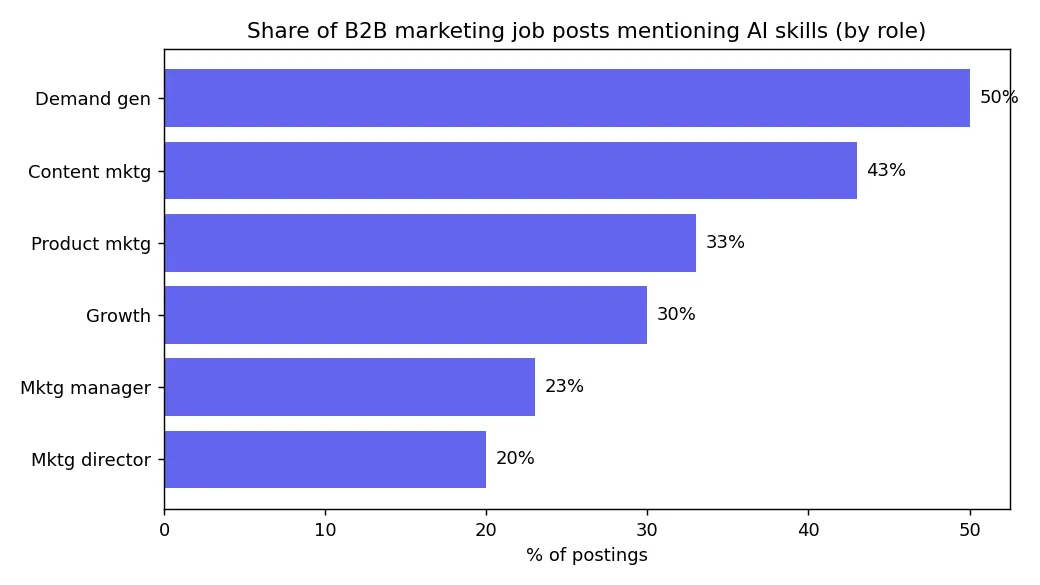
The numbers behind that chart:
| Role | % mentioning AI | n |
|---|---|---|
| Demand generation manager | 50% | 15/30 |
| Content marketing manager | 43% | 13/30 |
| Product marketing manager | 33% | 10/30 |
| Growth marketing manager | 30% | 9/30 |
| Marketing manager | 23% | 7/30 |
| Marketing director | 20% | 6/30 |
Demand gen sits at the top at 50%, content marketing right behind at 43%, and the two roles you might assume would lead the AI charge, the generalist marketing manager and the marketing director, sit at the bottom at 23% and 20%. That is the inversion worth sitting with. If you sketched this from intuition, you might expect leaders to be the ones pushing AI into the org, so their postings would name it most. In this snapshot it is the reverse. The job descriptions ask for AI most at the doing layer.
Why execution roles lead and leadership lags
A few plausible explanations, none of them certain.
The cleanest one is that demand gen and content are simply where AI already does the most visible heavy lifting. Drafting, variant generation, campaign volume, list research, ad iteration: these are exactly the tasks generative tools accelerate today, so it is reasonable that employers name AI tools when hiring for them. The work and the tooling map onto each other directly.
The leadership lag is more interesting, and I would hold it loosely. Director job descriptions tend to be written in the language of outcomes, headcount, and strategy rather than specific tools. A director posting that says nothing about ChatGPT is not telling you the director can skip AI fluency. It more likely reflects how senior job descriptions are written. So I would not read “directors at 20%” as “leaders do not need AI.” I would read it as “the hiring language for leaders has not absorbed AI as a named skill yet.” The doing layer names tools; the leadership layer names results.
There is also a sample-size caveat that bites hardest exactly here. Each role is only 30 postings, and the director cell is 6 mentions out of 30. A handful of differently worded postings would move that number several points. So the leadership-lag read is directional, a shape I would want to retest with a bigger pull, not a hard finding.
What this means for hiring and careers
A few practical reads, held loosely given the sample size:
- If you are in execution, AI is already on the table. Demand gen and content candidates should expect AI tooling named explicitly in postings, and a resume without it is starting to look like a gap. Half of demand gen postings mention it.
- If you are hiring leaders, do not let the language fool you. The fact that director postings rarely name AI does not mean the role can ignore it. If anything, the inversion is an argument to write AI fluency into senior job descriptions deliberately, because the market has not done it for you yet.
- The doing layer is the leading indicator. Where AI tooling shows up in job posts first tends to be where the productivity gains have already landed. Watch the execution roles to see where the leadership language will go next.
- Build the team around the capability, not the title. The split here is a useful prompt to make AI fluency a shared baseline rather than a few specialists, which is the approach I lay out in how to make your marketing team AI-native and the kind of work I do as a fractional AI marketing partner.
For the wider context on how fast AI is being adopted across marketing, my AI in B2B marketing statistics roundup pulls together the published numbers alongside this job-market scrape.
Methodology
I scraped 180 US B2B marketing job postings from Indeed, 30 each across six roles: demand generation manager, content marketing manager, product marketing manager, growth marketing manager, marketing manager, and marketing director. For each posting I ran keyword detection over the description text for AI terms, including ChatGPT, generative AI, machine learning, AI tools, and prompt. A posting counted as mentioning AI if any of those terms appeared anywhere in the text, then I grouped the results by role.
The caveats are real and worth stating plainly. This is one Indeed sample, US-only, captured as a single snapshot in time, with roughly 30 postings per role, which is small, and the director cell is smaller still in absolute mentions. Most importantly, this is keyword detection of AI mentions in the job description, which signals demand but is not the same as a hard requirement. A keyword match cannot tell a nice-to-have from a must-have, and job descriptions are written inconsistently across seniority levels, which is exactly the variable that could be driving the leadership-lag read. So every number here is directional, and the right way to read it is as a trend signal about where AI fluency is showing up in B2B marketing hiring first. If you want to talk through what AI fluency should mean across your team’s roles, I’m on LinkedIn.
FAQ
Which marketing roles are hiring for AI skills most in 2026? In a scrape of 180 US B2B marketing postings on Indeed, 30 per role, demand generation managers led at 50%, or 15 of 30. Content marketing managers were next at 43%, then product marketing at 33%, growth marketing at 30%, marketing managers at 23%, and marketing directors lowest at 20%. AI is named most in execution-heavy roles. The per-role samples are small and this is keyword detection, so treat the ranking as directional.
Do senior marketing roles mention AI skills less than junior ones? In this snapshot, yes, a notable inversion. Marketing director postings mentioned AI least at 20%, or 6 of 30, and generalist marketing manager postings were second-lowest at 23%, while demand gen and content led. One read is that leadership job descriptions favor the language of outcomes over tools. The director sample is only 30 postings, so the leadership-lag read is directional, not conclusive.
How big is the gap between the top and bottom roles? About 30 percentage points, with demand generation managers at 50% and marketing directors at 20%. That is a wide spread for a single job category and suggests AI fluency is showing up first at the doing layer rather than the leadership layer. With roughly 30 postings per role, the exact gap is fuzzy, but the direction holds across the execution-versus-leadership split.
Does an AI mention in a job post mean the role requires AI skills? No. This data detects whether AI terms appear anywhere in the text, and a mention can be a nice-to-have, a tool the team already uses, or a hard requirement. Keyword detection cannot tell them apart, so the honest read is that AI fluency is becoming a baseline hiring signal concentrated in execution roles, not that any given role formally requires it.