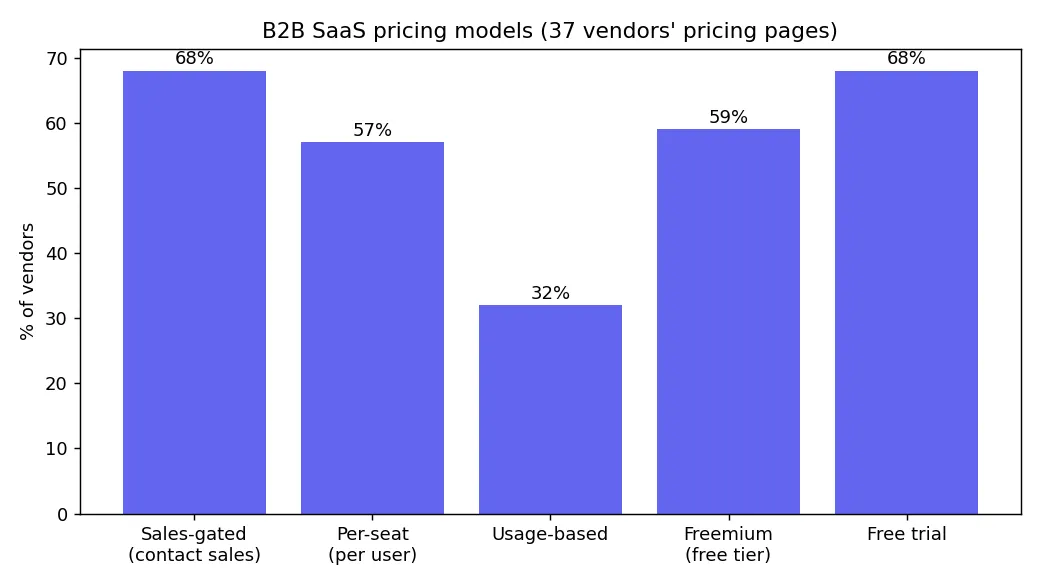
Usage-based pricing is still the minority in B2B SaaS: in a scan of 37 vendor pricing pages, just 32% showed a usage-based signal, roughly one in three, against 57% on per-seat and 68% on sales-gated tiers. So despite years of “usage-based is the future” discourse, per-seat and sales-gating still dominate, and consumption pricing sits at about a third. This is a contrarian cut of my wider B2B SaaS pricing models study, and every number here is directional, not definitive.
I’m Andrii Byzov, a fractional CMO for B2B SaaS, and I keep hearing in go-to-market circles that usage-based pricing is taking over. The data I gathered suggests the trend is real but overstated: usage-based is growing, yet the typical 2026 pricing page still anchors on seats plus a sales-gated enterprise tier. The headline is less “usage-based won” and more “usage-based arrived, and is still outnumbered.”
Key takeaways
- 32% of the 37 vendors showed a usage-based pricing signal. Real and growing, but still a minority at roughly one in three.
- 57% used per-seat (per-user) pricing, nearly double the usage-based share and still the most common explicit model.
- 68% were sales-gated and 68% offered a free trial, the two most common signals overall, both ahead of any pure pricing model.
- 59% had a freemium or free tier, making self-serve entry close to table stakes.
- Models overlap. Usage-based often appears as one dimension of a hybrid plan, not a standalone model, so the percentages sum to well over 100.
What the data shows
The gap between narrative and behavior is the whole story here. “Usage-based is the future” is one of the most repeated lines in B2B SaaS pricing content, and the direction of travel may well support it. But on this sample, usage-based pricing showed up on about a third of pages, while per-seat showed up on well over half. If usage-based were the new default, you would expect those numbers reversed, and they are not.
It helps to separate the underlying pricing model from the acquisition and packaging hooks layered on top. Free trial and sales-gating, tied at 68%, are the most common signals, but they describe how vendors open and close the funnel rather than how they meter value. Freemium at 59% sits in the same bucket. Among the actual metering models, per-seat at 57% leads usage-based at 32% by a wide margin.
Where usage-based does appear, it reads more like a component than a whole model. Many vendors pair a per-seat base with a usage dimension, for example seats plus metered API calls or events, rather than billing purely on consumption. That hybrid shape is consistent with the broader move toward product-led motions, which I cover in PLG versus sales-led GTM for B2B SaaS. For the full multi-model breakdown behind these figures, see the B2B SaaS pricing models study.
The numbers
The table below shows each model signal as a share of the 37 vendors analyzed. Because vendors combine models, a single vendor can appear in several rows, so the column does not sum to 100%.
| Pricing model signal | % of vendors |
|---|---|
| Sales-gated (contact sales / custom) | 68% |
| Free trial | 68% |
| Freemium / free tier | 59% |
| Per-seat (per-user) | 57% |
| Usage-based | 32% |
Sit with the bottom two rows for a moment. Per-seat at 57% against usage-based at 32% is a near two-to-one lead for seat pricing among these vendors. That is the line the hype tends to skip. It does not mean usage-based is failing; a third of vendors carrying a consumption signal is a meaningful presence, and the share is plausibly higher than it would have been a few years ago. It means the takeover, if it is coming, has not arrived on this sample yet.
What it means for go-to-market
If you are weighing a move to usage-based pricing, the practical read is patience over panic. The model is worth testing where consumption maps cleanly to value, which is exactly why it shows up so often in AI and infrastructure products. But a third of vendors is not a mandate to rip out seat pricing, and the cost of getting metered pricing wrong, in forecastability and buyer trust, is real.
The lower-risk first step most of your peers seem to take is adding a usage dimension to an existing per-seat plan rather than switching wholesale. That lets you learn whether your buyers will accept consumption billing before you bet the revenue model on it. Whether that is right for you depends on deal size, buyer type, and how tightly value tracks usage, which is the kind of trade-off I work through as a fractional CMO. If you want to model the spend side of a pricing or packaging change, the marketing budget calculator is a starting point.
The other honest reading is that sales-gating, not pricing model, may be the bigger lever on this data. With 68% of pages still routing at least one tier through sales, how you gate often shapes pipeline more than whether you bill per seat or per unit.
Methodology
I attempted to fetch the public pricing pages of 44 B2B SaaS vendors and successfully analyzed 37 of them. Seven were excluded because they had no fetchable standard pricing page at the time of the scan. The vendors were drawn from those that surface for common B2B SaaS software queries, which skews the sample toward established, well-indexed players rather than early-stage or niche tools, where usage-based pricing may be more common.
For each of the 37 pages, I ran keyword detection over the public pricing-page text. A model is counted as present if its signal appears in that text, for example consumption or usage language for usage-based, per-user or per-seat language for per-seat, and a contact-sales or custom-pricing phrase for sales-gated. This is automated signal detection, not a manual human audit of each plan, so it can miss a usage-based model that is present without the expected wording, or flag one mentioned only in passing.
Three caveats matter for the usage-based read specifically. The sample of 37 is small and skewed toward established vendors, so it likely understates usage-based adoption among newer AI-native tools. It is a single snapshot, and pricing pages change often. And because vendors routinely combine models, usage-based frequently appears alongside per-seat rather than instead of it, so the categories overlap and the percentages sum to more than 100%. Read the findings as directional signal, not a definitive census. If you want to talk through what your own pricing page is signaling, I’m on LinkedIn.
FAQ
Is usage-based pricing the standard in B2B SaaS in 2026? Not on this sample. Usage-based showed up on 32% of the 37 vendor pricing pages, roughly one in three, while per-seat appeared on 57% and sales-gated tiers on 68%. It is real and growing but not yet the norm, and the figure comes from keyword detection on a snapshot of established vendors, so read it as directional.
What share of B2B SaaS vendors use usage-based pricing? About 32% of the 37 vendors showed a usage-based or consumption signal, well behind per-seat at 57% and behind free trial and sales-gated tiers, both at 68%. Vendors often combine models, so usage-based frequently appears as one component of a hybrid plan rather than the whole model.
Why does usage-based pricing get so much attention if only a third of vendors use it? The discourse runs ahead of the behavior. Usage-based maps cleanly to AI and infrastructure products where consumption equals value, so it dominates commentary, but across this broader sample per-seat and sales-gating still anchor most pages. The trend is upward and the current level is a minority at the same time.
Should I switch my B2B SaaS to usage-based pricing? On this data, patience beats panic. It is worth testing where consumption maps to value, but a third of vendors is not a takeover, and per-seat remains the workhorse at 57%. Adding a usage dimension to an existing per-seat plan is often the lower-risk first step rather than a full switch.