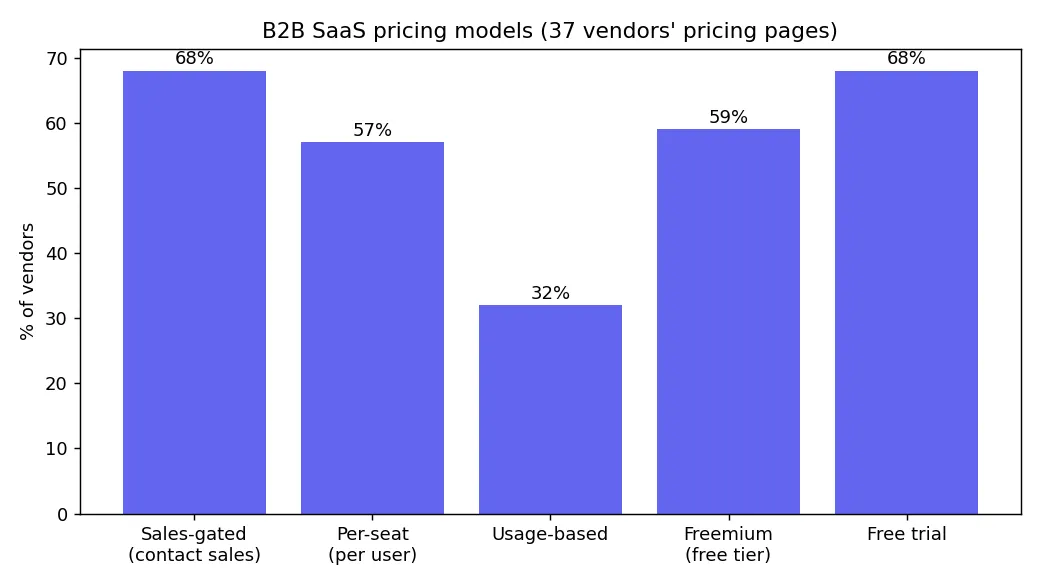
Most B2B SaaS vendors in 2026 acquire through a hybrid motion: a low-friction self-serve hook on the bottom of the market plus a sales-gated tier for enterprise. In a small original study of 37 vendor pricing pages, 68% offered a free trial, 59% had a freemium or free tier, and 68% kept at least one tier behind contact-sales or custom pricing. Those numbers overlap heavily, because the same vendor often runs a free hook and a sales-gated enterprise tier on the same page. Pure self-serve and pure sales-led both look like the exception, not the rule. Treat every figure here as directional, not definitive.
I’m Andrii Byzov, a fractional CMO for B2B SaaS, and this is an acquisition-model cut of the same pricing-page scan behind my B2B SaaS pricing models study for 2026. That post asked which pricing models vendors use. This one asks a narrower question: how do they actually get people in the door, and does the self-serve story hold up against the data?
Key takeaways
- 68% of the 37 vendors offered a free trial, making the time-boxed trial the most common self-serve hook.
- 59% had a freemium or free tier, so a permanently free entry point is now common rather than rare.
- 68% were sales-gated, keeping at least one tier behind contact-sales or custom pricing.
- The same vendors do both. Self-serve hooks and sales-gated tiers tie at the top, which points to a hybrid motion as the default.
- Categories overlap. Many vendors pair a free trial or freemium tier with a sales-gated enterprise tier, so the percentages sum to well over 100.
What the data shows
The headline is that the acquisition story is not a clean either-or. The loudest narrative in go-to-market circles says B2B SaaS is going self-serve and product-led, with free trials and freemium replacing the old sales-led playbook. On this sample, the self-serve hooks are clearly there, but they sit on top of a sales-led core rather than replacing it.
Free trials lead the acquisition signals at 68%. A free trial is time-boxed access to a paid plan, designed to let a buyer qualify themselves before talking to anyone. Freemium, a permanently free tier, showed up on 59% of pages. The two are different mechanisms and many vendors run both, so I would not over-read the gap between them. The fair summary is that a self-serve entry point of some kind has become close to table stakes for the vendors in this sample.
Then comes the twist. Sales-gating also lands at 68%, tying with free trials at the top. That is the same share of vendors keeping at least one tier behind contact-sales or custom pricing as the share offering a free trial. Because these categories overlap on individual pages, the most common shape is not self-serve or sales-led but both at once: a free hook to pull in the bottom of the market and a sales-gated enterprise tier to capture larger accounts. If you are weighing these motions against each other, my piece on PLG versus sales-led GTM for B2B SaaS works through when each one fits.
The numbers
The table below shows each acquisition signal as a share of the 37 vendors analyzed. Because vendors combine motions, a single vendor can appear in several rows, so the column does not sum to 100%.
| Acquisition signal | % of vendors |
|---|---|
| Free trial | 68% |
| Sales-gated (contact sales / custom) | 68% |
| Freemium / free tier | 59% |
A few things stand out. First, the tie between free trials and sales-gating at 68% is the clearest single piece of evidence for the hybrid read: vendors open the door with self-serve access, then route larger or custom deals through sales. Second, freemium at 59% suggests the free tier has moved from a differentiator to an expectation across much of the sample. Third, none of these are mutually exclusive, and the overlap is the actual finding. A vendor offering a free trial is often the same vendor gating its enterprise tier, so the two columns describe layers of one motion, not rival camps.
What it means for go-to-market
If you are designing or revisiting how you acquire, the practical read is that you probably do not have to choose between self-serve and sales-led, and most of your peers have not. The common 2026 shape is a free trial or freemium entry point for self-serve buyers, plus a sales-gated tier for enterprise where deals are genuinely custom. That is a defensible default rather than a hedge.
The harder calls are about where each piece earns its place. A self-serve hook only helps if a buyer can actually qualify and activate without a human, so a free trial wrapped in a forced demo is the worst of both worlds. On the other side, gating your entire pricing when a self-serve buyer could have qualified themselves is where you may leak pipeline to more transparent competitors. The right balance depends on deal size, buyer, and sales capacity, which is the kind of trade-off I work through as a fractional CMO. If the constraint is filling the self-serve top of funnel in the first place, that is a demand generation problem before it is a pricing one.
A note of caution on reading too much into any single number. This is a snapshot of mostly established vendors, and the presence of a free trial on a page does not tell you how well it converts. The data is good for sizing how common each motion is, not for proving which one performs.
Methodology
I attempted to fetch the public pricing pages of 44 B2B SaaS vendors and successfully analyzed 37 of them. Seven were excluded because they had no fetchable standard pricing page at the time of the scan. The vendors were drawn from those that surface for common B2B SaaS software queries, which skews the sample toward established, well-indexed players rather than early-stage or niche tools.
For each of the 37 pages, I ran keyword detection over the public pricing-page text. An acquisition signal is counted as present if its wording appears, for example a free-trial phrase for trial, a free-tier phrase for freemium, and a contact-sales or custom-pricing phrase for sales-gated. This is automated signal detection, not a manual human audit of each plan, so it can miss a motion that is present without the expected wording, or flag one mentioned in passing.
Three caveats matter. The sample of 37 is small and skewed toward established vendors, so it does not represent the long tail of B2B SaaS. It is a single snapshot in time, and pricing pages change often. And because vendors routinely combine motions on one page, the categories overlap and the percentages sum to more than 100%, so they describe how common each pattern is, not a breakdown of mutually exclusive groups. Read the findings as directional signal, not a definitive census. If you want to talk through what your own pricing page is signaling, I’m on LinkedIn.
FAQ
How do most B2B SaaS companies acquire customers in 2026? On this study of 37 vendor pricing pages, the dominant motion is hybrid: a low-friction self-serve hook plus a sales-gated tier. About 68% offered a free trial, 59% had a freemium tier, and 68% kept at least one tier behind contact-sales or custom pricing. Many combine both, so the percentages overlap and sum past 100, and the figures come from keyword detection on one snapshot, so read them as directional.
Is freemium or a free trial more common in B2B SaaS? On this sample, free trials edged ahead at 68% versus 59% for freemium, but the gap is small and the two are not mutually exclusive. A free trial is time-boxed access to a paid plan, while freemium is a permanently free tier, and plenty of vendors run both. The takeaway is that a self-serve entry point of some kind is now close to table stakes.
Do free trials and freemium mean B2B SaaS has gone fully self-serve? Not on this sample. The same 68% that offered a free trial sits next to 68% that kept a sales-gated tier, so most vendors layer self-serve acquisition on top of a still sales-led core. Pure self-serve and pure sales-led both look like the exception rather than the rule here.
Why do the acquisition percentages add up to more than 100%? Because vendors mix motions. A single vendor often pairs a freemium tier, a free trial, and a sales-gated enterprise tier on the same page, so it gets counted under several categories. The study measures each acquisition signal independently, not one label per vendor.