Which software vendors does AI recommend no matter who is asking? In this sample, almost none. I am Andrii Byzov, an AI-native fractional CMO and GEO consultant for B2B SaaS, and I ran 40 segment queries (“best {category} for startups”, “for small business”, “for enterprise”) through ChatGPT and Perplexity, then looked for sources cited across all three segments. The headline: HubSpot was the only software vendor cited in every segment. It appeared for startups (3 citations), small business (2) and enterprise (4). Most vendors lived in one bracket only. Salesforce was cited 5 times for enterprise and 0 elsewhere. Oracle was the same, enterprise 5 and 0 elsewhere. Spanning every segment in AI answers turns out to be rare, and that rarity is the story.
Key takeaways
- HubSpot was the only software vendor cited across all three segments in this sample: startups 3, small business 2, enterprise 4.
- Most vendors were segment-specific. Salesforce (enterprise 5, else 0) and Oracle (enterprise 5, else 0) were enterprise-only.
- Media sources span more easily than vendors. TechRadar was cited across all three (4/5/4), the most even spread of any source.
- Reddit spanned but faded toward enterprise (startups 4, small business 5, enterprise 2), strong for startups and SMB and weaker for enterprise.
- The realistic expectation: win AI visibility in one or two segments, not all three. Cross-segment presence is a sign of broad brand authority, and it is uncommon.
- Honest scope: 40 queries, roughly 13 per segment, US, one snapshot via ChatGPT and Perplexity, so read this as directional. Citation means visibility, not endorsement.
This is a different cut of the same dataset behind how AI’s recommendations shift by segment. That piece looked at how the answer changes from one segment to the next. This one asks the opposite question: which sources refuse to change, showing up no matter which buyer the query names.
The only vendor that spanned all three
The most useful way to read the data is to sort sources by how many segments cited them, not by raw count. On that view, the field thins out fast.
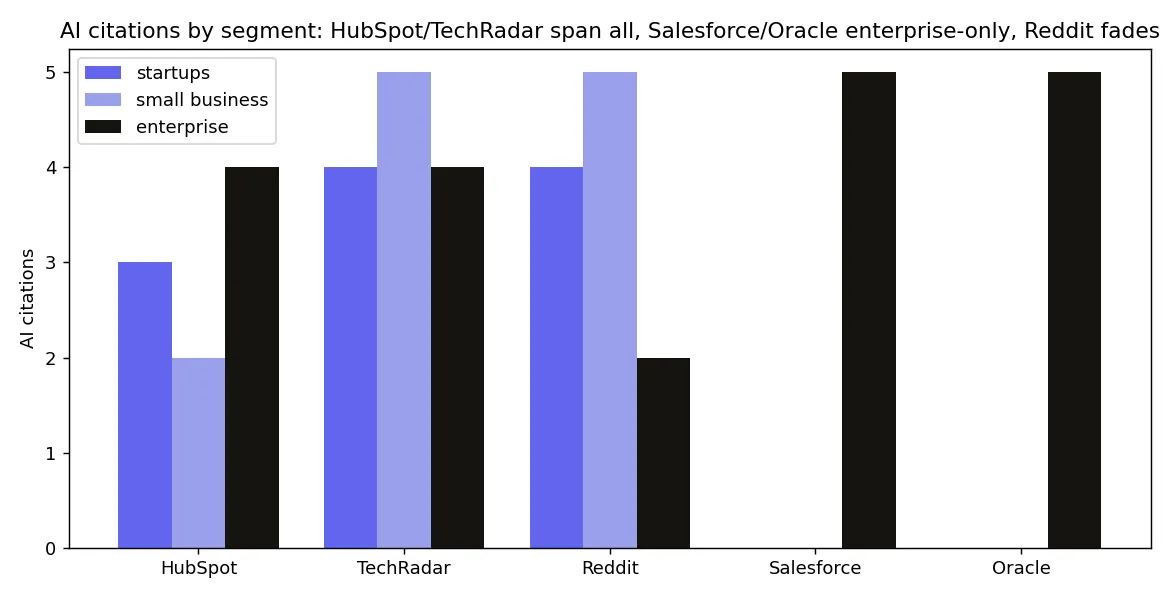
A handful of sources appeared in all three segments. As media, TechRadar spanned most evenly, cited 4 times for startups, 5 for small business and 4 for enterprise. Reddit spanned too, but faded as the buyer got larger: 4 for startups, 5 for small business, then only 2 for enterprise. That fade makes sense, since community threads carry more weight for self-serve buyers than for procurement-led ones.
Among actual software vendors, the list of all-three sources has exactly one name on it. HubSpot was cited for startups (3), small business (2) and enterprise (4). No other vendor in the set cleared the bar. The contrast is sharp when you put the enterprise incumbents next to it. Salesforce drew 5 enterprise citations and nothing for startups or small business. Oracle was identical, 5 for enterprise and 0 elsewhere. These are strong brands, but in AI answers they are strong in one bracket.
| Source | Startups | SMB | Enterprise |
|---|---|---|---|
| HubSpot (vendor) | 3 | 2 | 4 |
| TechRadar (media) | 4 | 5 | 4 |
| Reddit (community) | 4 | 5 | 2 |
| Salesforce (vendor) | 0 | 0 | 5 |
| Oracle (vendor) | 0 | 0 | 5 |
Read down the vendor rows and the pattern is hard to miss. HubSpot stretches across the table. Salesforce and Oracle sit in a single column. That is the difference between a brand the engines reach for whoever is asking and a brand the engines reach for only when the query says “enterprise”.
Why spanning segments is rare
It would be easy to read HubSpot’s spread as a fluke of small numbers, and the caveats below are real. But the structural reason fits the rest of the dataset. Segment-qualified queries reorder the recommendation set by buyer. Enterprise queries pull incumbents with seat-based contracts and procurement attached. Startup and small-business queries pull lighter, self-serve products plus a heavy dose of community and editorial. A vendor that wants to appear in all three has to be credible to buyers who want very different things, which most products are not.
HubSpot is instructive because its shape matches the requirement. A free tier keeps it in the startup and small-business conversation; an enterprise suite keeps it in the enterprise conversation. That range lets a single brand bridge segments the engines otherwise treat as separate. The enterprise-only skew of Salesforce and Oracle is the same coin flipped: deep in one bracket, absent from the others. I dig into that incumbent pattern separately in why AI recommends incumbents for enterprise buyers.
The data also suggests that media spans more easily than vendors do. TechRadar’s even 4/5/4 spread reflects how editorial “best X” coverage naturally addresses every buyer type. A vendor cannot lean on that. It has to earn citation as a product, segment by segment, and earning it everywhere is the exception.
What this means for your AI visibility
If you sell B2B SaaS, the honest planning read is humbling and clarifying at once. Most vendors should expect to win AI visibility in one or two segments, not all three. Spanning every segment is a sign of broad brand authority that few products have, and chasing it across the board is usually the wrong use of effort.
Three practical points follow, in this sample.
First, pick the segment where you can actually be cited. Being recommended for “best {category}” in general does not carry over to “best {category} for enterprise”. They behave like different queries with different winners. If you sell into the enterprise, the visibility job is to keep the company of the incumbents the engines already cite for that bracket. If you sell to startups, the job leans toward community and editorial mentions.
Second, treat cross-segment presence as an outcome of authority, not a target you force. HubSpot spanned segments because its brand and product range made it a sensible answer to every version of the question, not because it optimized for spread. Build authority in the segment that pays, and let spread follow if it follows at all.
Third, measure per segment. The same source counts differently depending on the buyer word in the query, so a single visibility number hides more than it shows. Tracking citations segment by segment is the work I do as a fractional CMO and GEO consultant: see GEO and AI search optimization.
So the directional read is this: in AI answers, spanning every buyer segment is rare, and among software vendors in this test only HubSpot managed it. That is not a verdict on who is best. It is a map of where each brand is currently visible, and for most vendors the realistic ambition is to own one or two segments well rather than all of them thinly.
Methodology
I assembled 40 segment queries across B2B SaaS categories, in three forms: “best {category} for startups”, “best {category} for small business” and “best {category} for enterprise”, roughly 13 per segment. I ran each through ChatGPT and Perplexity, recorded the cited domains, then counted how many of the three segments cited each source. The sources that appeared in all three are the subject of this piece. The cross-segment results: HubSpot (startups 3, small business 2, enterprise 4) as the only vendor spanning all three, TechRadar (4/5/4) as media spanning all three, and Reddit (4/5/2) spanning but fading toward enterprise. Enterprise-only examples included Salesforce (enterprise 5, else 0) and Oracle (enterprise 5, else 0).
Be clear on the limits. This is directional, not definitive. The counts are small, so HubSpot’s standing as the only cross-segment vendor is a signal rather than a settled ranking. Citation measures visibility, not endorsement, and being cited does not mean an engine called a vendor best. This is US context, one snapshot on a single date, and it excludes ads and other result types. Numbers will move when I re-run it. I write more about GEO on LinkedIn.
FAQ
Which vendor does AI recommend across every buyer segment? In this sample, HubSpot is the only software vendor cited across all three segments. Across 40 segment queries through ChatGPT and Perplexity, HubSpot appeared for startups (3 times), small business (2) and enterprise (4). Most vendors were segment-specific: Salesforce was cited 5 times for enterprise and 0 elsewhere, and Oracle was the same, enterprise 5 and 0 elsewhere. Media spanned more easily, with TechRadar across all three (4/5/4), but among actual software vendors HubSpot was uniquely cross-segment. Citation means visibility, not endorsement.
Why are most vendors recommended in only one or two segments? Because AI answers to segment-qualified queries reorder by buyer, in this sample. Enterprise queries pull incumbents with procurement attached, like Salesforce (enterprise 5, else 0) and Oracle (enterprise 5, else 0). Startup and SMB queries pull lighter, self-serve products plus community and editorial. Spanning all three asks a vendor to be credible to very different buyers at once, which is rare. The realistic expectation is to win AI visibility in one or two segments, not all three.
Do media sources span segments more easily than vendors? Yes, in this sample. TechRadar was cited across all three segments (startups 4, small business 5, enterprise 4), spanning more evenly than any vendor. Reddit spanned but faded toward enterprise (startups 4, small business 5, enterprise 2), strong for startups and SMB and weaker for enterprise. Among software vendors specifically, HubSpot was the only one cited in all three segments. So cross-segment presence is easier to earn as media than as a vendor.
How reliable is this cross-segment finding? It is directional, not definitive. I ran 40 segment queries, roughly 13 per segment, through ChatGPT and Perplexity in a US context on a single snapshot date. The counts are small, so HubSpot’s lead as the only cross-segment vendor is a signal rather than a settled ranking. Citation also measures visibility, not endorsement, and being cited does not mean the AI called a vendor best. Numbers will move on a re-run. Treat this as a pattern to plan around, not a scoreboard.