Does AI recommend different SaaS tools depending on whether the buyer sounds like an enterprise or a startup? In this sample, yes. I am Andrii Byzov, an AI-native fractional CMO and GEO consultant for B2B SaaS, and when I ran the same software categories through AI engines with two different framings, the recommended players split cleanly by segment. Enterprise-framed queries surfaced incumbent giants. Startup-framed queries surfaced accessible tools and community. Same categories, different names in the answer. This post is the sharp cut of that pattern. For the full dataset and overview, see how AI SaaS recommendations shift by segment.
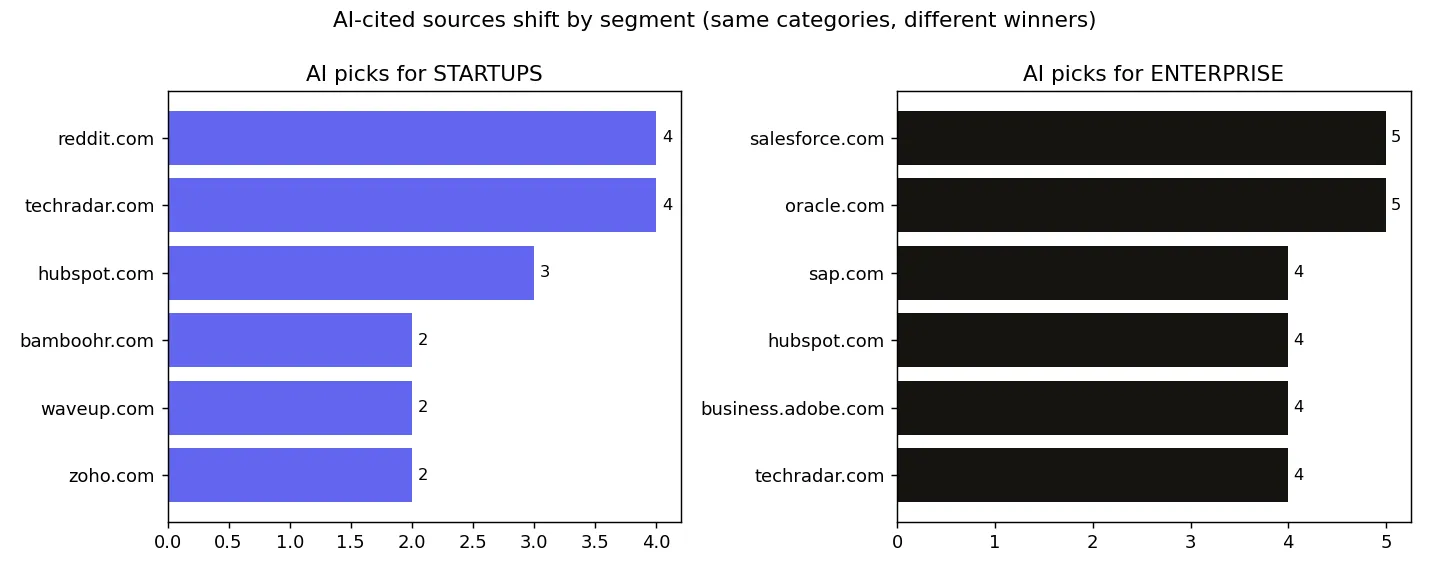
Across this 40-query US snapshot, the enterprise side leaned on salesforce, oracle, sap, adobe and servicenow, with hubspot and the review aggregator g2 also appearing. The startup side leaned on reddit, zoho, hubspot, bamboohr, brevo and mailchimp. Generative engine optimization (GEO) visibility, in other words, is not segment-neutral. The way a buyer frames intent appears to change which brands the engine reaches for.
Key takeaways
- For enterprise-framed queries in this sample, AI most cited incumbents: salesforce, oracle, sap, adobe, servicenow, plus hubspot and g2.
- For startup-framed queries, AI cited accessible tools and community instead: reddit, zoho, hubspot, bamboohr, brevo, mailchimp.
- The categories were the same. Only the segment framing changed, and the recommended players changed with it.
- HubSpot is the bridge name that showed up on both sides, which fits its mid-market-to-enterprise positioning.
- Reddit appears on the startup side, not the enterprise side, which hints that community presence weighs more for the startup audience.
- Honest scope: this is a 40-query US snapshot, ChatGPT answered about 95% and Perplexity about 85%, and a citation means visibility, not endorsement. Read it as directional.
This does not mean the enterprise tools are better or that AI is biased in any loaded sense. It means that, for this framing and this snapshot, the engines produced a recognizable pattern: authority-heavy names for enterprise intent, accessible and community-backed names for startup intent.
What the split looks like
Picture the same ten or so categories asked two ways. Ask them as an enterprise buyer and the answer fills with names that have been the category default for years. Ask them as a startup founder and the answer shifts toward tools that are cheaper to start, easier to self-serve, and widely discussed in community threads.
| Segment | Typical AI-cited players | What it implies |
|---|---|---|
| Enterprise | salesforce, oracle, sap, adobe, servicenow, hubspot, g2 | Incumbent authority and third-party corroboration appear to carry weight. To show up, you likely need recognized standing and credible outside references. |
| Startup / SMB | reddit, zoho, hubspot, bamboohr, brevo, mailchimp | Community presence and an accessible-tool reputation appear to matter more. Reddit visibility and being known as approachable and low-cost seem to help. |
The shape is the story. The two columns share almost no names except HubSpot, which straddles mid-market and enterprise and so plausibly earns citations on both sides. Everything else diverges. The enterprise column reads like a procurement shortlist. The startup column reads like a founder asking peers in a forum.
Why incumbents win the enterprise answer
For enterprise-framed queries, AI reached for the established giants. That is consistent with how these engines tend to weight signals: enterprise buying involves risk, compliance and scale, and the content that exists around enterprise software is dense with analyst coverage, case studies, integrations and third-party references. An engine assembling an answer to an enterprise-flavored question has a lot of corroborating material pointing at salesforce, oracle, sap, adobe and servicenow.
The presence of g2 on this side reinforces the point. Review aggregators are exactly the kind of third-party corroboration that lends an answer confidence. So the directional read is that, for enterprise intent, AI visibility looks tied to recognized authority and to being referenced by independent sources, not just to publishing your own pages. A challenger trying to break into these answers is, in effect, up against decades of accumulated corroboration.
Why challengers and community win the startup answer
For startup-framed queries, the picture inverts. Reddit appears prominently, which it did not on the enterprise side. Zoho, bamboohr, brevo and mailchimp show up: tools widely known as accessible, affordable and easy to adopt without a procurement cycle. HubSpot persists here too, on the strength of its free-tier and SMB reputation.
The plausible reading is that, for startup intent, the engine leans on where founders actually talk and on tools that match a self-serve, budget-conscious profile. Community discussion (Reddit) and accessible-tool reputation seem to do more work than analyst-grade authority. I broke out Reddit’s outsized role in organic SaaS discovery separately in why Reddit dominates Google’s SaaS comparison results, and its appearance on the startup side of AI answers rhymes with that.
What this means for positioning
If the segment changes the cast of the answer, then your GEO and positioning should match the segment you actually win in. A few implications follow from the data, hedged appropriately.
If you sell into enterprise, in AI answers you are up against incumbent giants. Authority and third-party corroboration plausibly matter heavily. That points toward earning analyst mentions, building credible case studies, getting onto and maintaining standing on review platforms like G2, and making sure independent sources reference you. Trying to out-publish Salesforce on your own blog alone is unlikely to move an enterprise-framed answer much.
If you target startups and SMB, community presence and being known as an accessible tool appear to matter more. That points toward genuine Reddit and community engagement, a clear self-serve story, transparent and approachable pricing, and word-of-mouth in the places founders gather. The startup-side names earned their citations partly by being talked about, not only by being authoritative.
The trap is matching the wrong playbook to your segment: chasing analyst authority when you sell to founders, or leaning on community buzz when you sell to enterprise procurement. Measure your own queries both ways, because the winners differ by framing. This is the work I do as a fractional CMO and GEO consultant: see GEO and GEO consulting. I also write more about this on LinkedIn.
Methodology
I ran a set of B2B SaaS categories through AI engines twice, once with enterprise framing and once with startup framing, recording which brands were cited in the answers. Across this 40-query US snapshot, ChatGPT answered about 95% of queries and Perplexity about 85%. I then compared the most-cited players on each side.
Be clear on the limits. This is one snapshot, on a single date, in US context. A citation means a brand was visible in the AI answer, not that the engine endorsed or judged it best. I am describing an observed pattern by segment framing, not claiming incumbents are objectively better or that AI is biased in any loaded sense. The counts are directional and will move when I re-run it. For the complete segment dataset this cut is drawn from, see how AI SaaS recommendations shift by segment.
FAQ
Does AI recommend different SaaS tools for enterprise versus startup queries? In this sample, yes. Asked with enterprise framing, AI most often cited established incumbents: salesforce, oracle, sap, adobe and servicenow, plus hubspot and g2. Asked with startup framing for the same categories, AI cited more accessible tools and community: reddit, zoho, hubspot, bamboohr, brevo and mailchimp. Same categories, different players by segment. This is a 40-query US snapshot, directional, and a citation means visibility, not endorsement.
Which players did AI cite for enterprise SaaS queries? For enterprise-framed queries, AI leaned on incumbent giants: salesforce, oracle, sap, adobe and servicenow appeared most, with hubspot and the review aggregator g2 also present. The read is that established-vendor authority and third-party corroboration carry weight in enterprise answers. It does not mean these tools are better, only that they were cited more for this framing.
Which players did AI cite for startup SaaS queries? For startup-framed queries, AI cited more accessible tools and community: reddit, zoho, hubspot, bamboohr, brevo and mailchimp appeared most. Reddit on the startup side suggests community discussion and an approachable, lower-cost reputation matter more here. This is directional, and a citation reflects visibility, not a recommendation quality judgment.
How complete is this segment dataset? It is directional, not definitive. This is a 40-query US snapshot run on a single date, with ChatGPT answering about 95% of queries and Perplexity about 85%. A citation means the brand was visible in the AI answer, not that the engine endorsed it. I am describing an observed pattern by segment framing, not claiming incumbents are objectively better or that AI is biased in any loaded sense. Numbers will move when I re-run it.