Does AI recommend the same B2B SaaS vendors no matter who is asking? No. In this sample, the segment word in a query changes the answer more than almost anything else. I am Andrii Byzov, an AI-native fractional CMO and GEO consultant for B2B SaaS, and I ran 40 segment queries (“best {category} for startups”, “for small business”, “for enterprise”) across 12 software categories through Google (pulled via Apify), ChatGPT and Perplexity. The headline: for the same category, AI recommends very different vendors depending on the buyer segment in the query. Ask for an enterprise tool and you get incumbents like Salesforce, Oracle and SAP. Ask for a startup tool and you get accessible products and Reddit threads.
Key takeaways
- For the same category, AI-cited winners shift sharply by segment. Startups pulled reddit, techradar, hubspot, zoho, bamboohr and waveup; small business pulled techradar, reddit, uschamber, brevo, mailchimp, activecampaign and klaviyo; enterprise pulled salesforce, oracle, sap, hubspot, adobe, servicenow and g2.
- Enterprise queries surface incumbents; startup queries surface accessible tools and community. The segment qualifier reorders the recommendation set.
- A Google AI Overview was present on 40 of 40 segment queries (100%), the highest rate of any intent I have measured.
- Segment intent diverges most from Google. Per-query overlap between AI-cited domains and Google’s top 10 averaged just 16%, the lowest of the four intents I have tested.
- The overlap ladder by intent: segment 16%, discovery 22%, comparison 34%, pricing 57%. Segment is the bottom rung.
- Honest scope: ChatGPT answered about 95% and Perplexity about 85% of the 40 queries, so read the AI side as directional.
This is the fourth buyer intent I have run through the same overlap method, and it sits at the divergent end. Where pricing queries showed AI and Google converging at 57% overlap, segment queries pull the two surfaces apart.
The same category, three different answers
The most striking thing in the data is not that AI and Google differ. It is that AI differs from itself depending on who the buyer says they are.
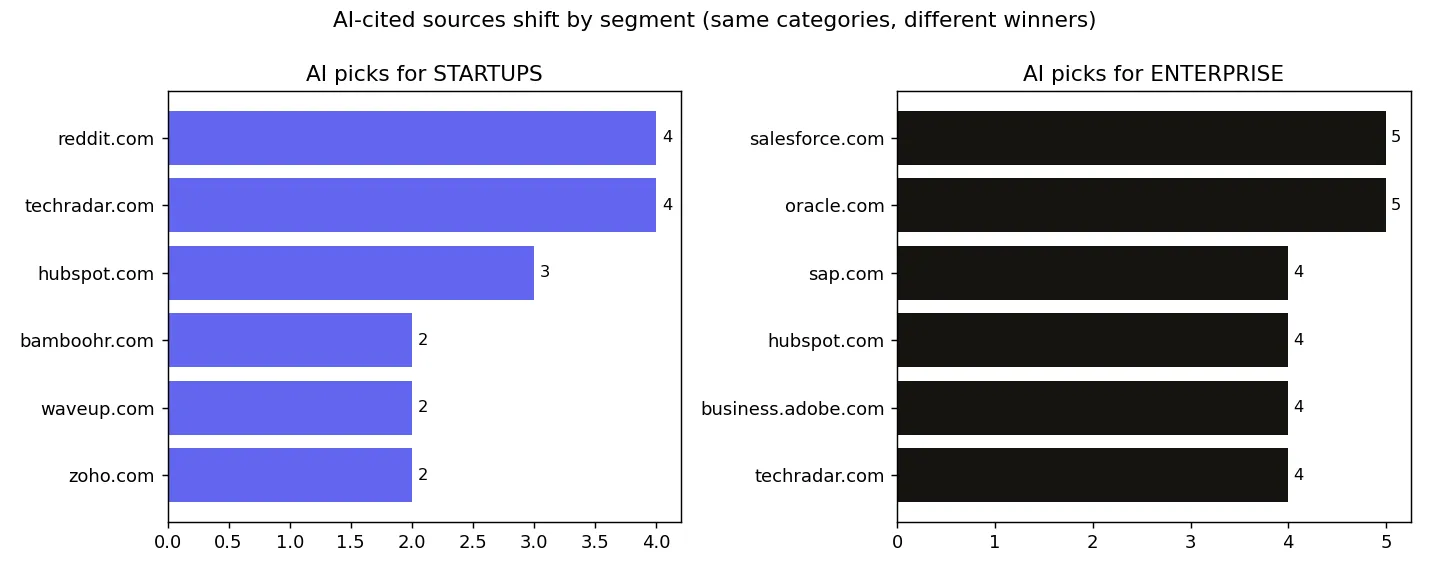
Take any one of the 12 categories and ask three versions of the question. The AI-cited recommendation set reshuffles each time. For startups, the engines leaned on a mix of community and accessible products: reddit, techradar, hubspot, zoho, bamboohr and waveup. For small business, the set tilted toward marketing and email tooling buyers in that bracket actually use: techradar, reddit, uschamber, brevo, mailchimp, activecampaign and klaviyo. For enterprise, the answer changed character entirely: salesforce, oracle, sap, hubspot, adobe, servicenow and g2.
| Segment | Top AI-cited sources | Character |
|---|---|---|
| Startups | reddit, techradar, hubspot, zoho, bamboohr, waveup | Community and accessible tools |
| Small business | techradar, reddit, uschamber, brevo, mailchimp, activecampaign, klaviyo | SMB marketing and editorial |
| Enterprise | salesforce, oracle, sap, hubspot, adobe, servicenow, g2 | Incumbents and review aggregators |
Read down the table and the pattern is hard to miss. Enterprise queries pull established platforms, the names with seat-based contracts and procurement attached. Startup and small-business queries pull lighter, self-serve products and a heavy dose of community and editorial sources like Reddit, TechRadar and the US Chamber of Commerce. HubSpot is the one name that bridges all three, which fits its free tier plus enterprise suite. The incumbent skew on enterprise queries is a pattern I dig into separately in why AI recommends incumbents for enterprise buyers.
For a vendor, the practical reading is uncomfortable but useful: being cited for “best {category}” in general does not mean you are cited for “best {category} for enterprise”. They are, in effect, different queries with different winners.
Segment intent diverges most from Google
Now layer Google on top. I have run the same per-query overlap analysis across four buyer intents, and segment queries sit at the divergent extreme.
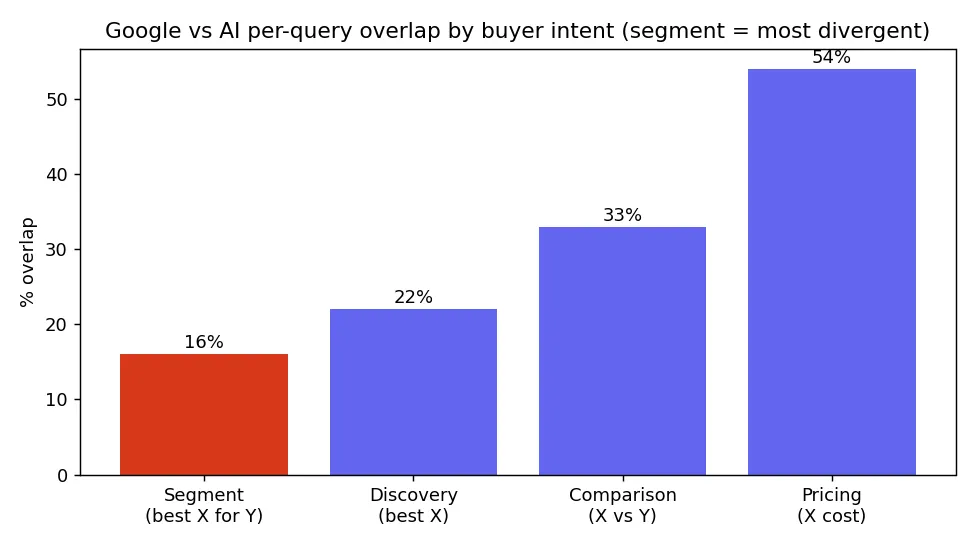
Per-query overlap between AI-cited domains and Google’s top 10 averaged just 16% for segment queries. That is the lowest of the four intents I have tested: segment 16%, discovery (‘best X’) 22%, comparison 34%, pricing 57%. In other words, when a buyer qualifies a search by segment, Google and the AI engines reach for the most different sources of any stage in the funnel.
Why would segment intent diverge most? My working explanation, and it is a hypothesis rather than a finding, is that segment qualifiers ask the engine to make a judgment, not just retrieve a page. “Best CRM for enterprise” has no single canonical destination the way “Salesforce pricing” does, so Google and the AI engines each form their own view of what “for enterprise” means and weight different signals. The result is the inverse of pricing intent, where both surfaces point at one obvious page. This pattern across the funnel is the throughline of my GEO vs SEO benchmark.
The takeaway is not that Google work is wasted here. It is that for segment queries, ranking in Google’s top 10 is the weakest predictor of getting cited by AI that I have measured. The two need to be planned as separate surfaces.
AI Overviews are universal on segment queries
There is one place where segment queries do not diverge: Google almost always generates an AI Overview for them. An AI Overview was present on 40 of 40 segment queries, which is 100%. That is the highest rate of any intent I have run, above the prevalence I found for discovery and comparison searches.
This fits the divergence finding. A segment-qualified query invites synthesis, because no single page settles “best {category} for startups”, so Google reaches for an AI-generated answer nearly every time. The moment a buyer adds “for startups” or “for enterprise”, they are very likely to see synthesis at the top rather than ten blue links. Two caveats stand: AI Overview presence is a separate measure from which sources get cited, and this is one US snapshot, so the rate could ease on a re-run.
What this means for segment-stage visibility
Segment-qualified queries are where a buyer has told you exactly who they are. That is high-value context, and three things follow from the data, in this sample.
First, GEO has to be planned per target segment. Because the same category yields different AI recommendations for startups, small business and enterprise, a single “be the best {category}” content effort will not cover all three. If you sell into the enterprise, your visibility job is to be in the company of the incumbents the engines already cite for that bracket. If you sell to startups, the job looks more like earning community and editorial mentions. These are different motions.
Second, the divergence from Google is something to plan around. At 16% overlap, your Google ranking for “best {category} for enterprise” tells you little about whether AI will cite you for it. Measuring both surfaces, per segment, is the only way to know where you stand. This is the work I do as a fractional CMO and GEO consultant: see GEO and AI search optimization.
Third, the AI Overview is the default on these queries. With an Overview on 40 of 40 segment queries, the question is not whether a buyer sees synthesis, but whether you are inside it for the segment that matters to you. The sources AI trusts for “enterprise” are not the sources it trusts for “startups”.
So the directional read is: segment intent is where AI recommendations fragment by buyer, where Google and AI agree least, and where AI Overviews are most universal. That combination makes segment-qualified queries one of the highest-leverage and least interchangeable surfaces to plan for.
Methodology
I assembled 40 segment queries across 12 B2B SaaS categories: the segment-qualified set such as “best {category} for startups”, “best {category} for small business” and “best {category} for enterprise”. This is a new dataset, the fourth buyer intent in this series, distinct from my discovery, comparison and pricing benchmarks, so the four intents can be compared on the same overlap method.
For the Google side, I pulled the top organic results per query via Apify and recorded the ranking domains. A Google AI Overview was present on 40 of 40 queries, 100%, though I scored organic domains, not the Overview itself. For the AI side, I ran each query through ChatGPT and Perplexity and recorded cited domains; ChatGPT answered about 95% and Perplexity about 85% of the set. I then computed per-query overlap between AI-cited domains and Google’s top 10, which averaged about 16%, and compared it to the discovery (22%), comparison (34%) and pricing (57%) intents from earlier runs.
Be clear on the limits. This is directional, not definitive. The AI side is partial because not every query was answered, which makes the AI-cited counts conservative. AI Overview presence is a separate measure from which sources get cited. This is US context, one snapshot on a single date, and it excludes ads, maps and other result types. Numbers will move when I re-run it. I write more about GEO on LinkedIn.
FAQ
Does AI recommend different SaaS vendors for startups versus enterprise? Yes, sharply, in this sample. Across 40 segment queries over 12 B2B SaaS categories, the AI-cited winners changed by segment: startups pulled reddit, techradar, hubspot, zoho, bamboohr and waveup; small business pulled techradar, reddit, uschamber, brevo, mailchimp, activecampaign and klaviyo; enterprise pulled salesforce, oracle, sap, hubspot, adobe, servicenow and g2. Enterprise queries surfaced incumbents, startup queries surfaced accessible tools and community. The segment word in the query changes the answer.
Do segment queries trigger AI Overviews in Google? Almost always, in this sample. A Google AI Overview was present on 40 of 40 segment queries, which is 100%, the highest rate of any intent I have measured. So if a buyer adds “for startups” or “for enterprise” to a “best X” search, they are very likely to see an AI-generated answer at the top of Google. That makes segment-qualified queries a high-stakes surface for visibility, though AI Overview presence is not the same as which sources get cited.
Which intent diverges most between AI and Google? Segment intent, in this sample. Per-query overlap between AI-cited domains and Google’s top 10 averaged just 16% for segment queries, the lowest of the four intents I have tested: segment 16%, discovery (“best X”) 22%, comparison 34%, pricing 57%. So when a buyer qualifies a query by segment, Google and the AI engines pull from the most different sources. That is the opposite end of the funnel from pricing, where the two surfaces agree most.
How complete is this segment-query dataset? It is directional, not definitive. I ran 40 segment queries across 12 B2B SaaS categories. ChatGPT answered about 95% and Perplexity about 85% of them. Google had an AI Overview present on all 40, though I scored organic domains, not the Overview itself. This is US context, one snapshot on a single date, and it excludes ads and other result types. Treat the numbers as a signal rather than a settled measurement.