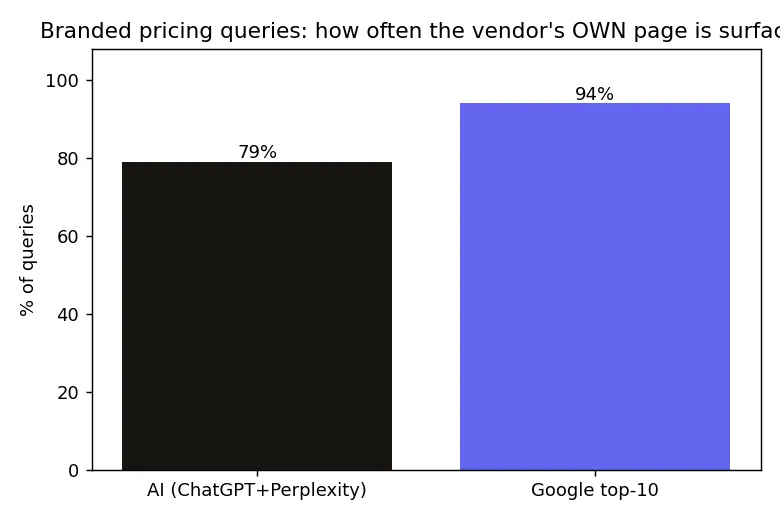
For branded pricing queries, the asset AI and Google surface most is your own pricing page. In the pricing-intent study, when a buyer searched for a specific vendor’s pricing, the vendor’s own domain was surfaced by AI engines (ChatGPT and Perplexity combined) 79% of the time, and by Google 94% of the time. So your pricing page is the single most reliably surfaced asset for pricing intent. The catch is that many B2B SaaS pricing pages are sales-gated or thin, which wastes the one piece of real estate the engines reliably reach for.
I’m Andrii Byzov, a fractional CMO for B2B tech, and pricing intent is one of the highest-stakes moments in the buyer journey. When someone asks an AI engine or Google what you cost, they are deep in evaluation, and the answer they get shapes whether you make the shortlist. Because your own page is what gets surfaced most, it is the place to spend effort first. For the full dataset behind these numbers, see AI and Google for SaaS pricing queries. For the pricing models themselves, see B2B SaaS pricing models in 2026.
Key takeaways
- Your own page wins pricing intent. AI surfaced it 79% of the time, Google 94%, for branded pricing queries.
- It is your top GEO asset for cost questions, so it earns first attention.
- Gated or thin pages waste it. The study found 68% of vendors are sales-gated.
- You can keep contact sales and still give real context, ranges, and structure.
- GEO improves the odds. It does not guarantee what a model says, because you do not control the output.
Why your own page is the asset that matters here
Most GEO advice points off-site, toward review sites, communities, and best-of lists, because those sources get cited heavily for comparison and evaluation queries. Pricing intent is the exception. When the query names your brand and asks about cost, both AI and Google reach for your own domain first, far more than for most other query types. A 79% AI hit rate and a 94% Google hit rate mean your page is almost always in play.
That is leverage you rarely get in GEO. For most queries you compete to be cited among sources you do not own. Here, the engines already favor the page you fully control. The only way to lose that advantage is to give the page nothing worth surfacing, which is exactly what a sales-gated or thin page does. With 68% of vendors sales-gated, most of the market is leaving this on the table.
The fix without abandoning contact sales
You do not have to publish a full price list to make this page work. Plenty of B2B SaaS keeps a sales motion for good reasons, and that is fine. The goal is to keep the contact-sales step while giving AI and Google something real to read, structure, and trust. A page can say talk to us and still be substantive. Here is the checklist I run with clients, with the reason each step helps the engines surface and use the page well.
-
Give real context and ranges where you can. Even a starting-from figure, a typical range, or the variables that drive price (seats, usage, modules) gives the engines something concrete to extract instead of a blank wall. AI repeats what it can read; a page with substance beats a page with a form.
-
Structure tiers clearly. Name each tier, state who it is for, and list what it includes. Clear structure is easier for a model to parse into a clean answer and easier for Google to pull into a snippet, so the surfaced result reflects you accurately rather than a guess.
-
Add answer-shaped FAQ. Write direct questions and answers: what is included in each plan, who each tier suits, what drives the price, whether there is a free trial. Answer-shaped content is some of the easiest text for a model to lift verbatim, which raises the chance your own wording is what gets surfaced.
-
Mark it up with schema. Product and Offer markup removes ambiguity about what the page is and what each tier represents. Schema does not buy a result, but it makes the page easier to interpret cleanly, which helps both engines describe it correctly. See schema markup for AI search.
-
Make it crawlable, not JavaScript-only or gated. If the meaningful content only renders client-side, or sits behind a form, the engines may never see it. Serve the substance in the HTML and keep the gate to a clear next step, not the whole page. A page that cannot be read cannot be surfaced.
-
Keep it current. Update prices, tier names, and inclusions when they change. Stale numbers create contradictions across your own pages and third-party sources, and an engine that sees conflicting facts tends to hedge or pick a clearer rival. Consistency is what makes a model confident enough to use your page.
-
Keep the entity consistent. Make sure the pricing model you describe here matches what your listings, profiles, and review-site entries say. When your core facts agree everywhere, the engines treat your page as the authoritative source rather than one of several conflicting ones.
How the steps reinforce each other
These are not seven separate projects. Real context and clear tiers give the model something to extract; answer-shaped FAQ gives it clean text to lift; schema and crawlability let it read all of that; currency and entity consistency make it confident the page is right. Run them together and you turn the one asset the engines already favor for pricing intent into a page they can surface accurately.
A house rule keeps this honest: GEO improves the odds, it does not guarantee an outcome. You do not control what a model says, outputs vary by query, and they shift over time. What you can do is make your own page the clearest, most current, most crawlable source for your pricing, so that when the engines reach for it, as the data says they usually do, they find something worth surfacing. Be skeptical of anyone selling certainty here.
FAQ
Is my own pricing page really what AI surfaces for pricing queries? For branded pricing queries, yes, more often than anything else. AI engines (ChatGPT and Perplexity combined) surfaced the vendor’s own domain 79% of the time, and Google 94% of the time. That makes your pricing page the single most reliably surfaced asset for pricing intent. It is not a guarantee for every query, but no other source comes close to that hit rate.
Can I keep contact sales and still have a good GEO pricing page? You can. Keeping a sales motion does not require a thin page. The study found 68% of vendors are sales-gated, and many give almost nothing to read. Add real context, ranges where you can share them, clear tiers, and answer-shaped FAQ. You keep the contact-sales step while giving AI and Google something extractable, which tends to improve the odds rather than guarantee them.
What makes a pricing page easy for AI and Google to use? Crawlable, structured, and current. Make sure content renders in the HTML rather than only in JavaScript, and that nothing important hides behind a form. Structure tiers with names, who they are for, and what each includes. Add answer-shaped FAQ and Product or Offer schema. Keep prices and tier names up to date so the page does not contradict other sources.
Will a strong pricing page guarantee AI shows the right price? No. A clear, crawlable, current page improves the odds that AI and Google surface your own page and describe it accurately, but you do not control model outputs, and they vary by query and shift over time. You are stacking the deck toward your own page being the surfaced source, not buying a guaranteed result. Anyone promising guaranteed pricing accuracy in AI answers is overselling it.
If you want your pricing page and the rest of your site built to be surfaced and cited, that is core to what I do as a fractional CMO. Start with my GEO offer or AI search optimization, and find me on LinkedIn.
Andrii Byzov is a fractional CMO for B2B tech, focused on AI-native marketing and AI search visibility.